
Multivalent systems
Nowadays, and particularly in the future, there are usually several different types of heat generator available for heat generation. Conventional and electric hot water boilers and heating boilers are therefore combined with CHP units or heat pumps. However, solar thermal systems or biomass boilers may also be included.
This has advantages, particularly in terms of:- Flexible, optimised economic operation tailored to the fuel prices
- The carbon footprint of heat generation
- The availability of fuels or heat sources
- The availability of heat generation in the event of a component failure
For most system designs, larger heat cylinders are also used in this context.
To achieve optimal integration, it is important to take into account the often necessary variable operating conditions of all consumers. In this context, it should be possible to answer at least the following questions for all operating states of the system involving generators, consumers and cylinders:
- When is each heat generator in operation?
- What are the maximum and minimum operating conditions for the heat generators?
- What are the maximum and minimum operating conditions for the heat consumers?
- What temperature level and heat output does this cover?
- What different heat generators are required to cover the required heat demand at the consumers?
- What temperature level do the heat consumers currently require?
- What is the target temperature at which the buffer cylinder is designed to operate?
- How much heat can be stored in the cylinder by which heat generator at what temperature level?
- When is the cylinder charged, and when is it discharged?
When integrating different heat generators into the flow and return pipes to the consumer circuits, particular attention must be paid to the flow temperatures and the partial-load control of the respective components.
At each node (connection point branch) of the system, the mass flows and temperatures mix depending on the operating states.


At each node (connection point branch) of the system, the mass flows and temperatures mix
To make the best possible use of the cylinder’s heat storage capacity, the generation component with the highest flow temperature (often the CHP unit in heating systems) should be connected closest to the cylinder.
Heat generators that operate more efficiently at the lowest possible temperatures, such as heat pumps, can then be integrated directly into the return.
The burner-fired and electric hot water boilers offer the greatest flexibility in this system. They can handle both variable return temperatures and variable flow temperatures, and also cover a wide range of partial loads.
Another key factor in ensuring the system operates optimally from both a technical and operational perspective is flow temperature control for the consumer circuits, which can be easily achieved using a three-way valve. This ensures that consumers are always provided with exactly the temperature they need.
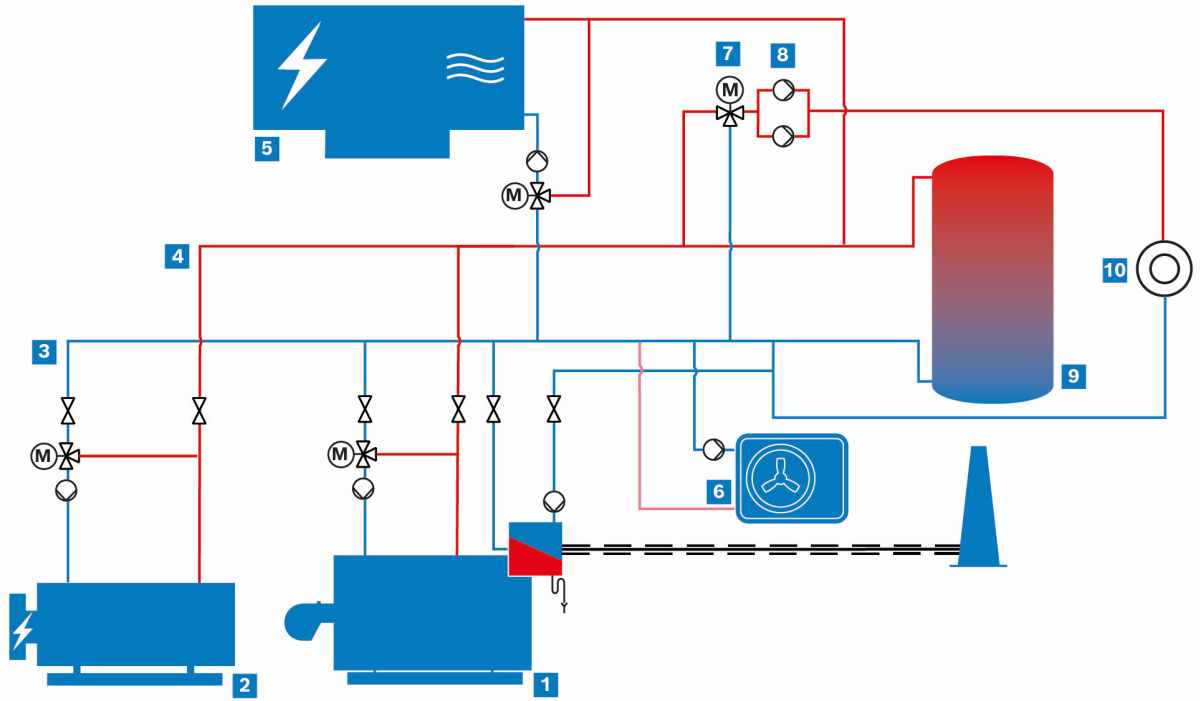
Diagram of a hot water boiler system as a multivalent system
|
|
Hot water boiler |
|
|
Electric hot water boiler |
|
|
Return |
|
|
Flow |
|
|
CHP system |
|
|
Heat pump |


|
|
Three-way valve for the flow temperature control |
|
|
Mains-powered circulation pumps |
|
|
Heat cylinder with hydraulic separation |
|
|
Heat consumer |


