

Fundamentals
Fuel costs account for the majority of the running costs of a boiler system. In order to assess the energy efficiency of hot water boiler systems, it is important to consider not only their efficiency, but also, and in particular, their actual seasonal efficiency.
In addition to fuel costs, electricity, chemicals, water and waste-water, spare parts and downtime costs must also be monitored and optimised.
Net calorific value, gross calorific value
The net calorific value (”lower net calorific value”; Hu or Hi) is the energy released during the complete combustion of any type of fuel when the flue gas is cooled back down to the reference temperature at constant pressure. In this case, the water vapour created in the flue gas during combustion remains gaseous. The net calorific value therefore only indicates the thermal quantity contained in the flue gases that is directly dependent on the temperature, but not the heat quantity of condensation bound in the water vapour.
The gross calorific value (“upper heating value”; Ho or Hs) is the energy released during the complete combustion of any type of fuel when the flue gas is cooled back down to the reference temperature at constant pressure and the entire volume of water produced is condensed. The gross calorific value therefore also includes the condensation heat, which is also referred to as “latent heat”.
Depending on the fuel, the gross calorific value is between approximately 6.8 % (fuel oil) and 10.8 % (natural gas H) higher than the net calorific value.
|
Material value |
Symbol |
Unit |
Natural gas L |
Natural gas H |
Propane |
Butane |
Fuel oil |
EL fuel oil |
HVO* |
Hydrogen |
|
Lower |
Hi |
kWh/m³ |
8.83 |
10.35 |
25.89 |
34.39 |
11.89 |
11.89 |
9.2–9.5 |
3.0 |
|
Upper |
Hs |
kWh/m³ |
9.78 |
11.46 |
28.12 |
37.23 |
12.70 |
12.70 |
10.0–10.3 |
3.54 |
|
Ratio |
Hs/Hi |
% |
110.8 |
110.7 |
108.6 |
108.3 |
106.8 |
106.8 |
112 |
118 |
|
Dewpoint |
tCond |
°C |
56.9 |
57.0 |
53.1 |
52.4 |
48.6 |
48.6 |
40–55 |
71 |
|
Acid |
tCond |
°C |
– |
– |
– |
– |
124 |
97 |
– |
– |
|
Water |
Wspec.H2O |
gH2O/kWh |
159.4 |
158.5 |
126.9 |
122.0 |
100.5 |
100.5 |
131 |
226.8 |
|
pH value |
pH |
– |
2.8–4.9 |
2.8–4.9 |
2.8–4.9 |
2.8–4.9 |
1.8–3.7 |
2.3–4.5 |
– |
– |
Characteristics of various fuels
1) Based on Hi
Modern heat recovery and flue systems made from corrosion-resistant materials (e.g. suitable stainless steels) can be used to partially condense the water vapour from the flue gas. By using this condensing technology, the efficiency can then rise to over 100 %, as it is based on the lower net calorific value.
Efficiency is always calculated based on the net calorific value of a fuel because, in the past, it was essential to keep the water vapour in the flue gas in gaseous form in order to prevent flue gas condensation and possible corrosion of the boiler or flue system, or sooting of the fireplace.
However, in order to make sensible use of condensing technology, cold medium at ≥ 10 K below the dewpoint temperature is required, i.e. maximum 45 °C for natural gas.
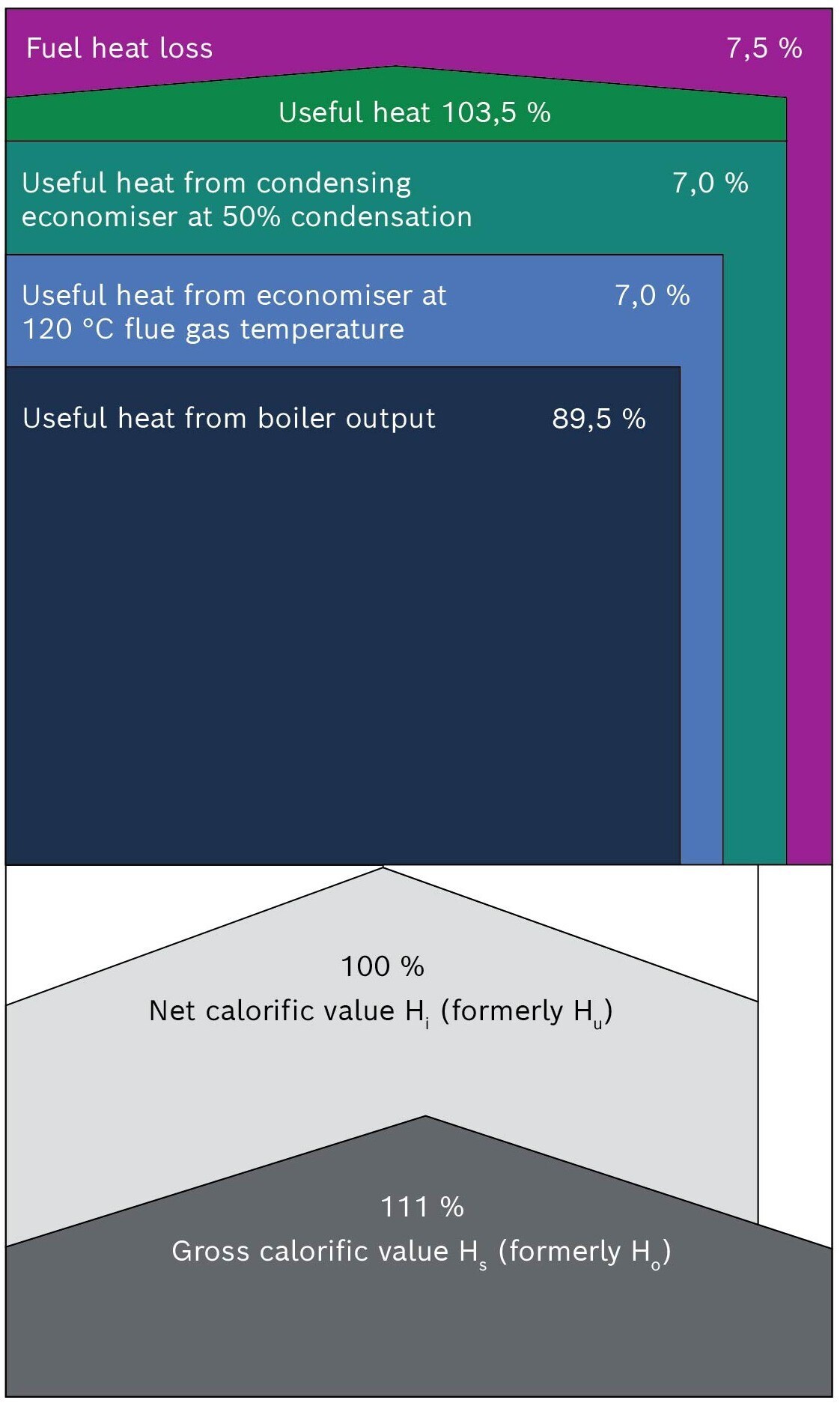
Heat balance of a hot water generator with condensing technology and gas combustion (values are examples)