
Fossil fuels
Widespread availability, high gross calorific value and a good cost-benefit ratio make the fossil fuels natural gas and fuel oil attractive. As a result, they are still the most commonly used fuels in industrial systems today. Energy costs are the most important factor in the choice of energy source for the majority of industrial companies. However, bans, subsidies and penalties for CO2 emissions influence these cost considerations through their impact on the overall cost analysis.
Criteria for choosing between fuel oil and natural gas as a fuel
The following table summarises the most important factors influencing fuel selection (German Federal Statistical Office). While fuel oil is now used almost exclusively as a backup fuel in Germany and Europe, natural gas is only just beginning to gain ground in some regions of the world. In some countries, however, fuel oil remains the fuel of choice due to its low local price and the lack of gas infrastructure.
|
Criterion |
EL fuel oil |
Natural gas |
Electricity (green*) |
|
Fuel store |
Yes |
No |
No |
|
Connection required? |
No |
Yes |
Yes |
|
Available everywhere |
Yes |
No |
No |
|
Control range |
Up to 1:5 |
Up to 1:10 |
0 – 100 % |
|
Heating surface contamination |
Low |
None |
None |
|
Efficiency without |
Good |
Good |
Up to 99.6 % |
|
Efficiency with |
Excellent for low-sulphur EL |
Excellent |
Up to 99.6 % |
|
Fuel supply |
Required |
Not required |
Not required |
|
Pollutant emission |
Low |
Very low |
None* |
|
CO2 generation |
~ 266 gCO2/kWh |
~ 200 gCO2/kWh |
0 gCO2/kWh |
Price trends for energy sources for industrial customers in Germany
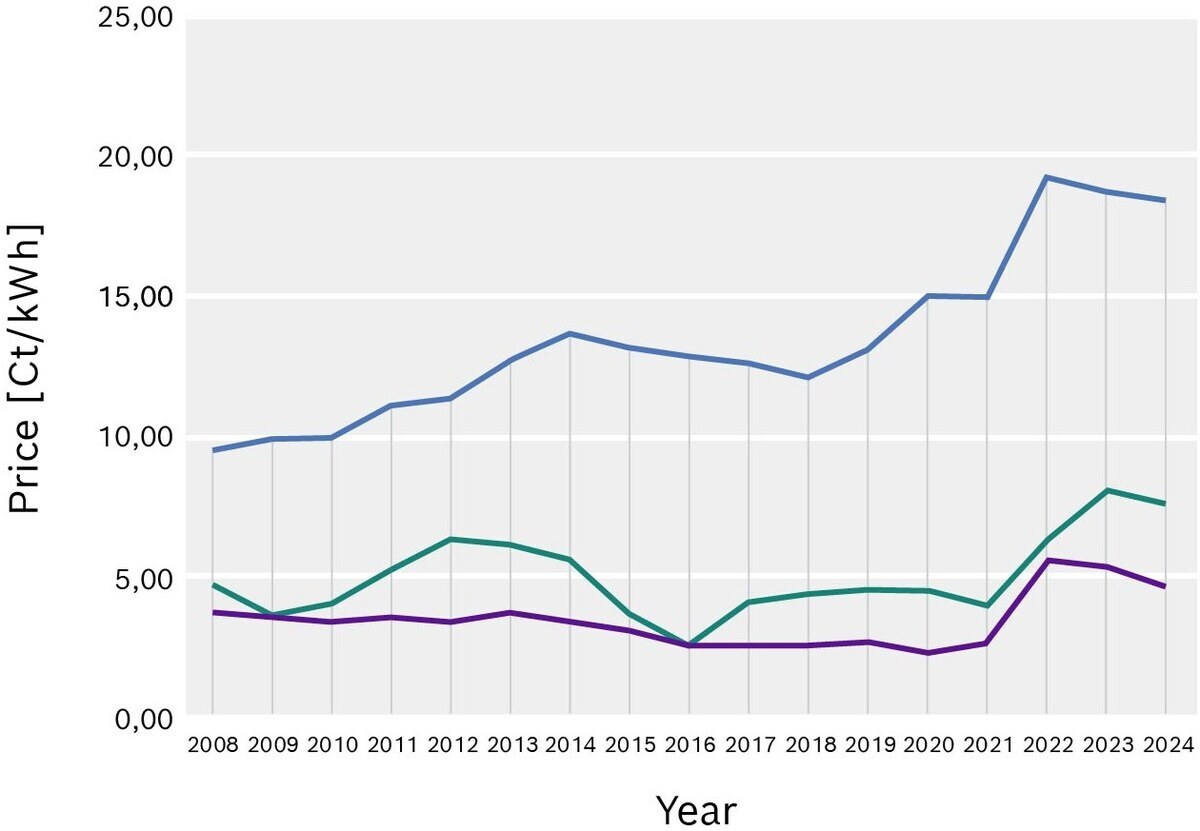
Price trends for energy sources for industrial boilers in Germany from 2008–2024 (source: destatis.de)
|
|
|
Electrical current |
|
|
|
Light fuel oil |
|
|
|
Natural gas |


Natural gas and “green gas” contracts
If natural gas is available at the planned installation site of the boiler, the use of natural gas is generally recommended. Connection to the supply network eliminates the need for fuel storage, and switching suppliers is easy in the liberalised gas market. The space required for the gas transfer station is significantly less than that required for an oil storage tank, including ancillary facilities. In addition, natural gas from the public network is fully suitable for use with condensing technology, as the gas, which consists mainly of methane, has a high hydrogen content (CH4). Contracts for climate-neutral gas can also be concluded – this is fed into the network at another location. In this case, the reductions in emissions do not take place at the company’s own chimney, but in the balance sheet of the network’s customers.
Another argument in favour of gas as a fuel is that the control range for partial load operation is significantly greater than for oil, thus enabling greater savings. While oil burners usually only achieve a partial load range of 1:5, modern gas burners can cover twice the partial load range, i.e. a control range of up to 1:10.
To design the gas fuel supply, the net calorific value of the gas, the gas flow pressure available at the boiler installation site and the maximum gas quantity supplied via the gas connection must be specified. This information can be obtained from the local gas network operator.
Fuel oil
When using mineral oils as fuel, additional requirements under water and fire protection regulations must be observed, particularly during delivery, storage and distribution.
Important requirements for combustion systems are contained in the country-specific combustion regulations (FeuV). Requirements for heating oil storage and transport are contained in the Ordinance on Facilities for Handling Substances Hazardous to Water and on Specialist Companies (VAwS). Depending on the contents and location of a heating oil tank, the federal states in Germany prescribe one-off or recurring inspections by experts. This is regulated differently around the world and must be checked locally.
EL fuel oil
Extra-light (liquid) fuel oil is reliably available everywhere and is usually delivered by tanker truck. The following types of EL fuel oil are available in Germany:
- EL fuel oil
- Low-sulphur EL fuel oil
- Bio EL fuel oil
The most commonly used type of fuel oil is low-sulphur EL fuel oil with a maximum sulphur content of 50 mg/kg. Due to lower taxation, it has a market share of almost 100 %. It is also suitable for condensing technology, as it has an even lower tendency to cause contamination than standard EL fuel oil.
EL Bio fuel oil is low-sulphur fuel oil mixed with up to 5, 10 or 15 % liquid fuel from renewable raw materials. This is currently usually biodiesel.
The minimum requirements and tests for EL fuel oil are specified in DIN 51603-1.
S fuel oil
The heavy fuel oil type S is used almost exclusively in large industrial systems for hot water generators. It is produced during petroleum refining in the lower part of the distillation columns, known as the sump, where the petroleum components with a high boiling point are extracted. It mainly contains large, relatively heavy molecules such as longer-chain alkanes and alkenes, cycloalkanes and various aromatic hydrocarbons. In addition, there are various nitrogen and sulphur compounds.
Fuel oil S is viscous and must be heated to over 60 °C for transport through pipelines. The atomisation temperature required for combustion is actually between 100 – 160 °C. The requirements for atomisation viscosity are significantly higher for pressure atomiser burners than for rotary cup burners, which is why the fuel oil must be preheated to higher temperatures.
Heavy fuel oil contains up to 3.5 % sulphur by mass, tends to cause increased deposits in the flue gas path, and the flue gas should not be cooled below the acid dew point of approximately 120 – 150 °C. The higher flue gas temperature reduces the achievable efficiency by several percentage points. In addition, special measures are sometimes necessary to comply with flue gas emissions (e.g. urea injection).
The many disadvantages compared to EL fuel oil and natural gas cannot usually be offset by the lower price.