
Fundamentals of a hydraulic system
A hydraulic hot water system in industrial and larger heating systems is a complex arrangement of components that work together to generate, distribute and deliver heat to consumers. To this end, water is heated and circulated in mostly closed systems to provide a highly reliable supply of heat. The correct design, installation, maintenance and control of the system are crucial to ensure its efficiency and longevity. Below is a list of some important components of hydraulic systems in hot water and heating systems, along with a basic explanation of their function.
Heat generator/heat source
A heat generator or heat source is a component of every hydraulic hot water or heating system. This often consists of one or more hot water or heating boilers using conventional or alternative fuels. Over the last few years, electrically powered hot water boilers and heating boilers have also steadily gained market share. In addition to boiler systems, there are other heat generators such as heat recovery systems, combined heat and power (CHP) units, heat pumps and solar thermal systems.
Heat consumer
The heat generated is consumed by heat consumers, e.g. in district heating or local heating systems, as well as in buildings or industry. The application varies depending on the size of the system. Heat exchangers transfer heat to consumers in the system. The heat from the consumers is distributed to the end-users.
Pumps
Since water does not circulate through the system under its own pressure, the use of circulation pumps is essential. They ensure an even and demand-based water flow in the system right through to the end-user.
Pipework
Flow and return lines distribute the hot water throughout the building and return the cooled water to the generator for reheating. When considering the flow and return temperatures, it is important to bear in mind that most systems have several consumers and different temperature levels that can be controlled independently.
Fittings
In this context, fittings is the umbrella term for valves, controllers, flaps and gate valves used to regulate water flow in the system. Shut-off valves allow water flows to be shut off in certain pipes. Control valves control the flow and temperature of the water. These include temperature control valves, straight-through valves and mixing valves. Pressure-relief valves prevent excessive pressure in the system by discharging boiler or circuit water at the excess pressure. Spring-loaded pressure-relief valves are generally used here. Non-return valves prevent unwanted backflow of water and protect the system from pressure surges and contamination. Air vent valves allow trapped air, which could impair efficiency and function, to be released from the system.
Expansion and pressure maintaining systems
Expansion and pressure maintaining systems compensate for any losses and volume changes in the water at different temperatures and keep the pressure in the system stable.
Safety and control systems
Pressure gauges and temperature sensors continuously monitor the operating parameters of the system. Safety valves protect the system from overpressure, while control units automate the operation of the boiler and pumps using programmable controllers or smart thermostats.
End-user
The heat is transferred to end-users via collection points. These are found in single-family homes, multi-family houses and municipal buildings, e.g. radiators or panel heaters (floor, wall or ceiling heaters) for room heating, which release heat into the indoor air, or air heating registers, which blow heated air into the rooms. In industry, heat exchangers transfer thermal energy to the respective process medium.
Water treatment
Upstream water treatment ensures that the replenished water is of high quality in order to prevent corrosion, deposits and contamination. Water softeners remove calcium and magnesium ions in order to prevent limescale. Partial or full desalination systems reduce conductivity in order to reduce the tendency for corrosion in the hot water network. Filters remove particles and impurities from the water. Chemical additives protect against corrosion and biological growth (e.g. biocides and inhibitors). Partial water treatment with integrated filters, oxygen reduction or alkalisation, integrated as a bypass in the circulating water, ensures that the hot water quality is maintained.
Control
The control of a heating and hot water boiler has a significant influence on specific applications. The control is crucial for the efficiency, safety and productivity of hot water systems. It helps to save energy and costs, extend the service life of the system and improve process quality. Modern control systems offer flexibility and adaptability in order to meet the specific requirements of the system.
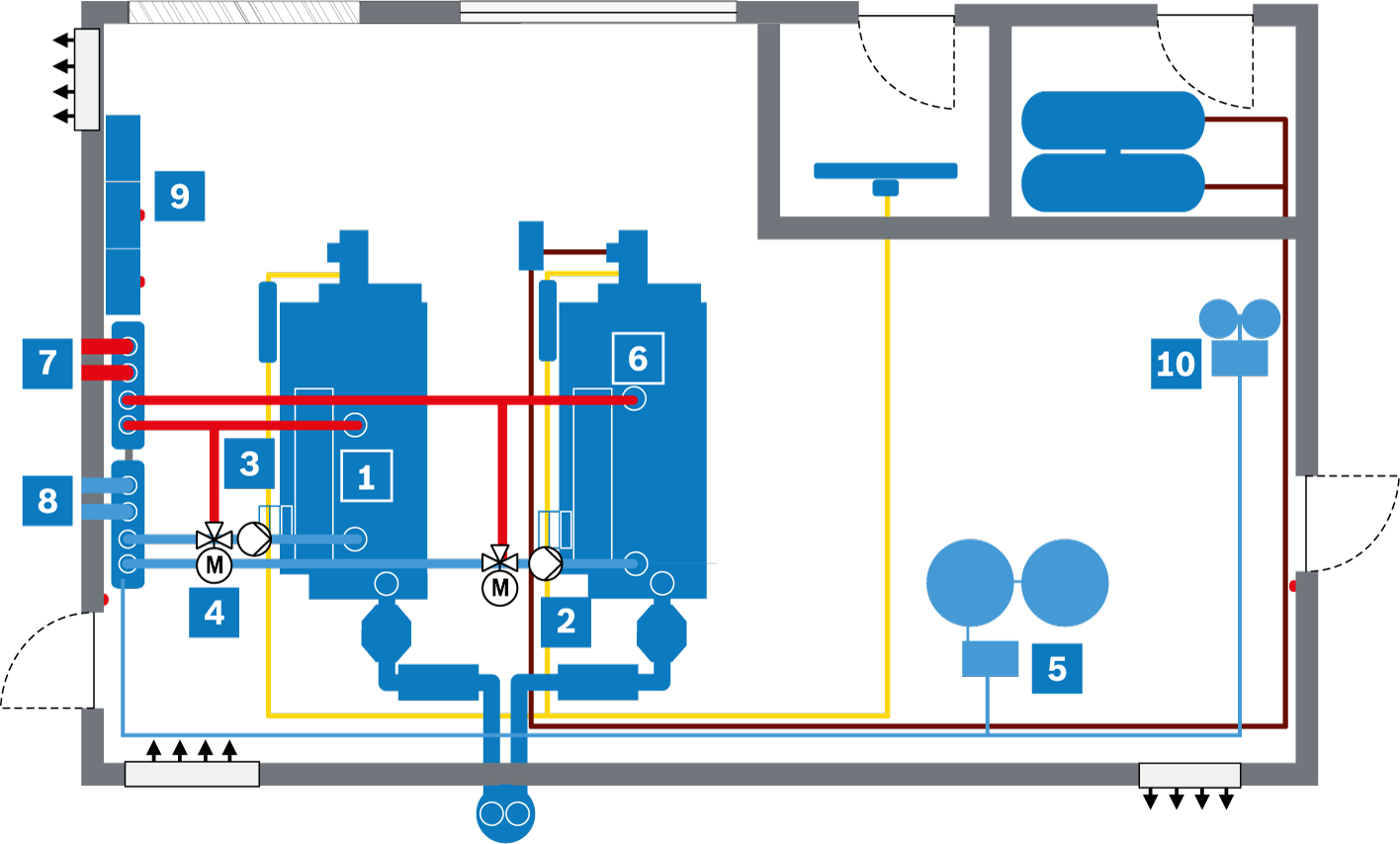
Typical structure of a boiler house (simplified representation)
|
|
Boiler |
|
|
Pumps |
|
|
Pipework |
|
|
Fittings |
|
|
Pressure-maintaining system |
|
|
Safety and control systems on the boiler |
|
|
Flow to the consumers |
|
|
Return from the consumers |
|
|
Control cabinet |
|
|
Water treatment |
|
|
Flow |
|
|
Return |
|
|
Gas |
|
|
Oil |


