
Types
Various designs have been developed in response to the specific requirements for heating and hot water boilers set out below:
- Installation
- Operation
- Pressure and output
- Low-emission combustion systems
- High efficiency rating
- Fuel
Three-pass boiler
The three-pass boiler consists of three horizontal flues, which are housed within a large cylindrical pressure vessel and sealed by two flat floors. All of the flues are located in the water chamber. These boilers are also known as shell boilers, as they contain a large volume of water.
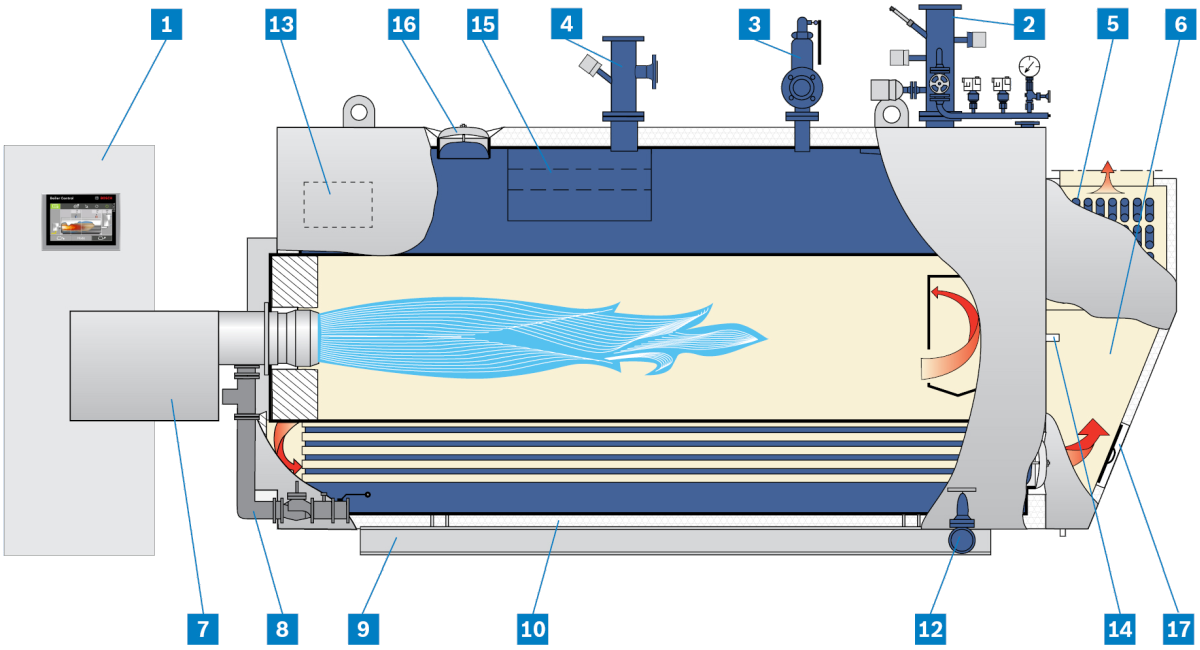
UT-H three-pass shell boiler
|
|
Control panel with BCO boiler control system or compact CWC hot water boiler control system |
|
|
Supply flow adapter piece with
|
|
|
Full-lift safety valve |


|
|
Return flow adapter piece
|
|
|
ECO flue gas heat exchanger |
|
|
Flue gas collection chamber |
|
|
Burner |
|
|
Gas regulation module |
|
|
Base frame |


|
|
Insulation with protective casing |
|
|
Drain shut-off valve, maintenance-free |
|
|
Terminal box |
|
|
Sight hole |
|
|
Injector device for internal temperature increase |
|
|
Inspection opening, water side |
|
|
Inspection opening, flue gas side |


Combustion takes place in the first pass, the flame tube. Here too, a good half of the heat is transferred to the flame tube walls, mainly through thermal radiation. At the end of the flame tube, combustion is complete and the flue gases are diverted into the internal, water-cooled reversing chamber and into pass 2.
Approximately 35 % of the heat output is then transferred in the tube area of pass 2. The flue gases then enter the front, external reversing chamber at a temperature of approximately 400 °C, where they are diverted into pass 3.
After pass 3, the gases usually still have a temperature of 200 – 280 °C, depending on the temperature of the medium in the boiler’s water chamber. This heat potential can then be further utilised in an integrated flue gas heat exchanger, resulting in a temperature of 90 – 140 °C at the flue outlet gas flange.
Single-tube boilers can achieve thermal outputs of up to 25 megawatts.
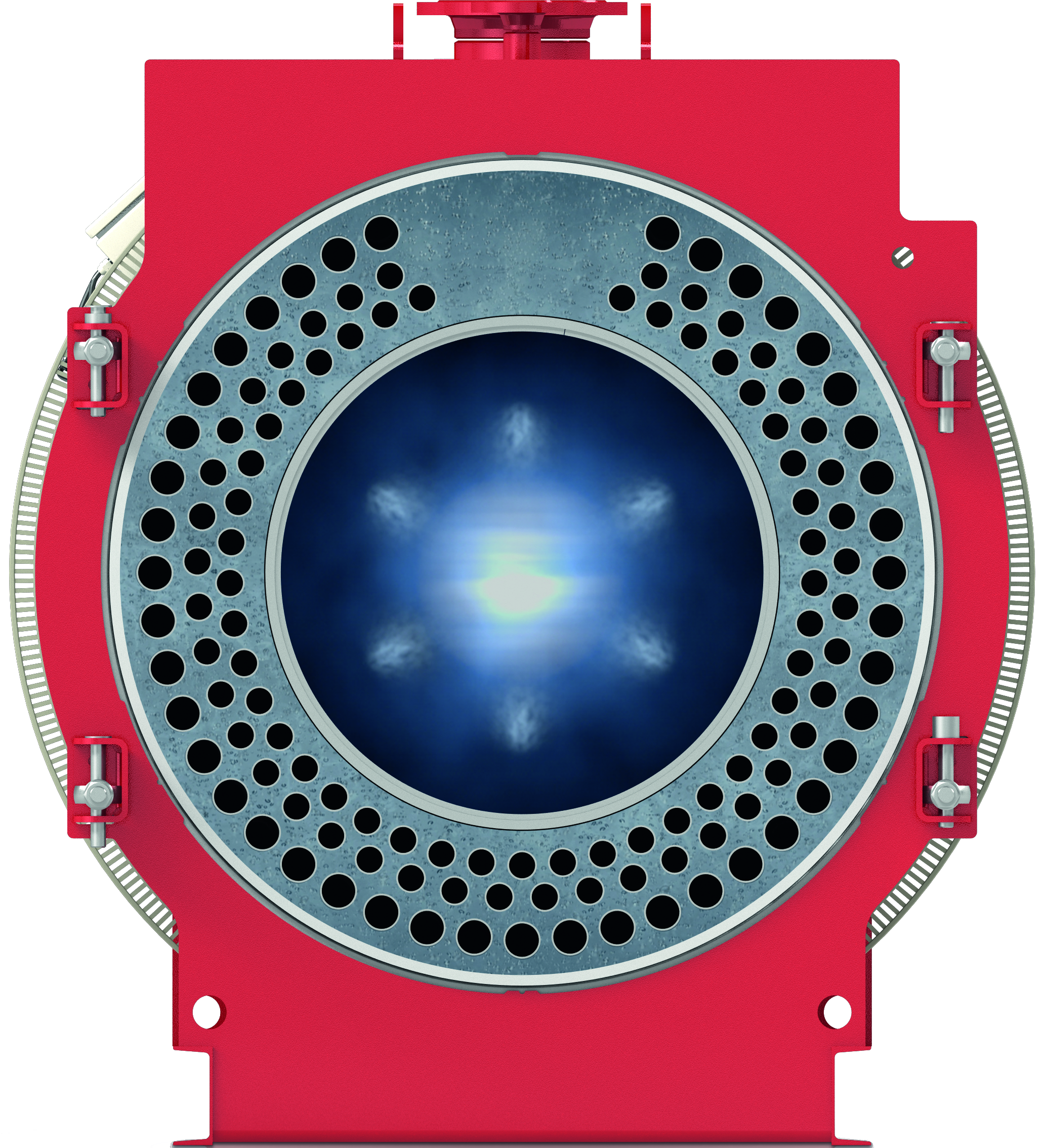
Twin fire tube boilers are available for higher output requirements. In this design, two flame tubes arranged in parallel are positioned in the water chamber, each with a separate second and third flue tube. This makes it possible to build boilers with a capacity of up to 38 megawatts. Unrestricted single flame tube operation also improves reliability and extends the control range.
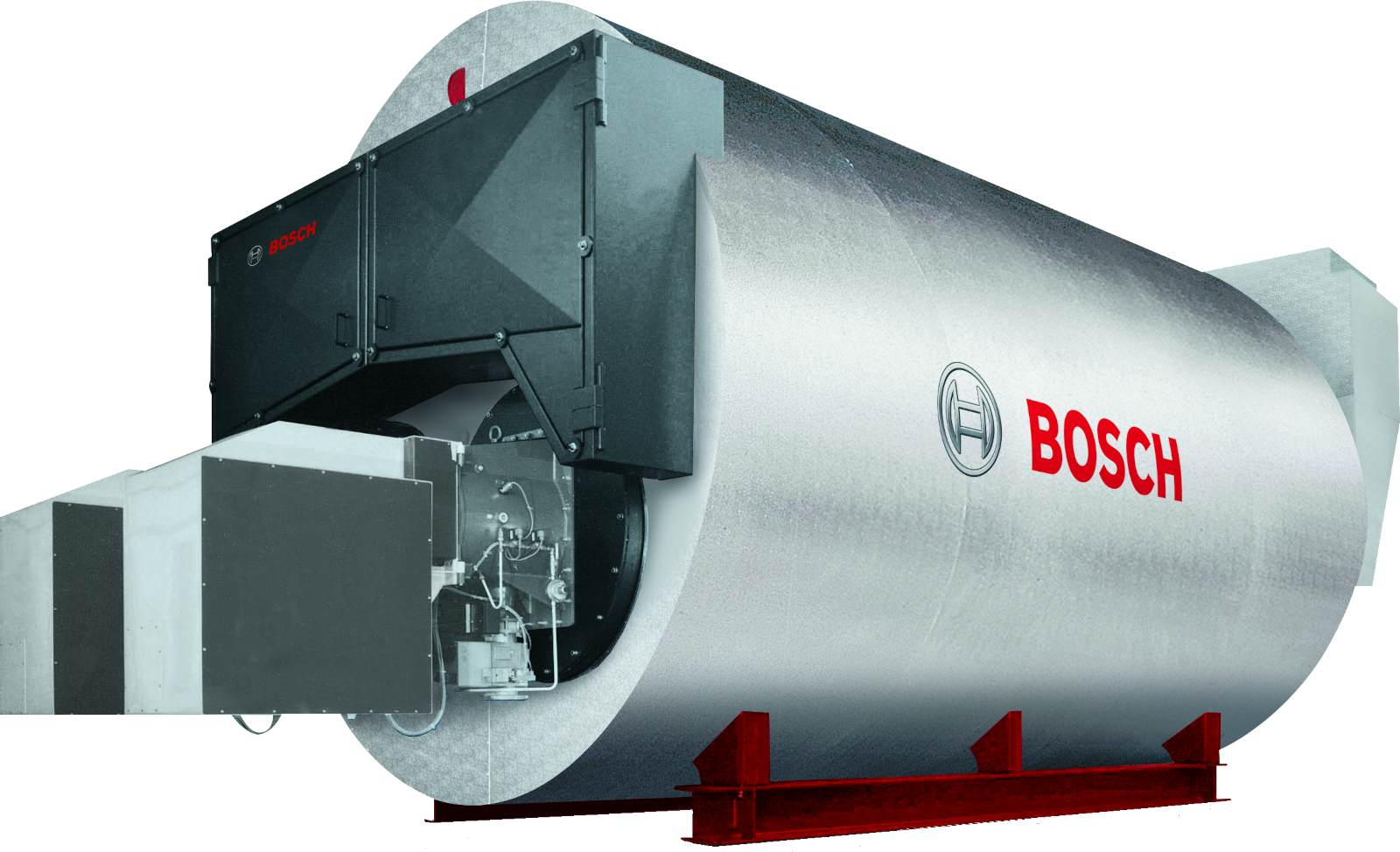
Three-pass shell boiler with a twin flame tube design
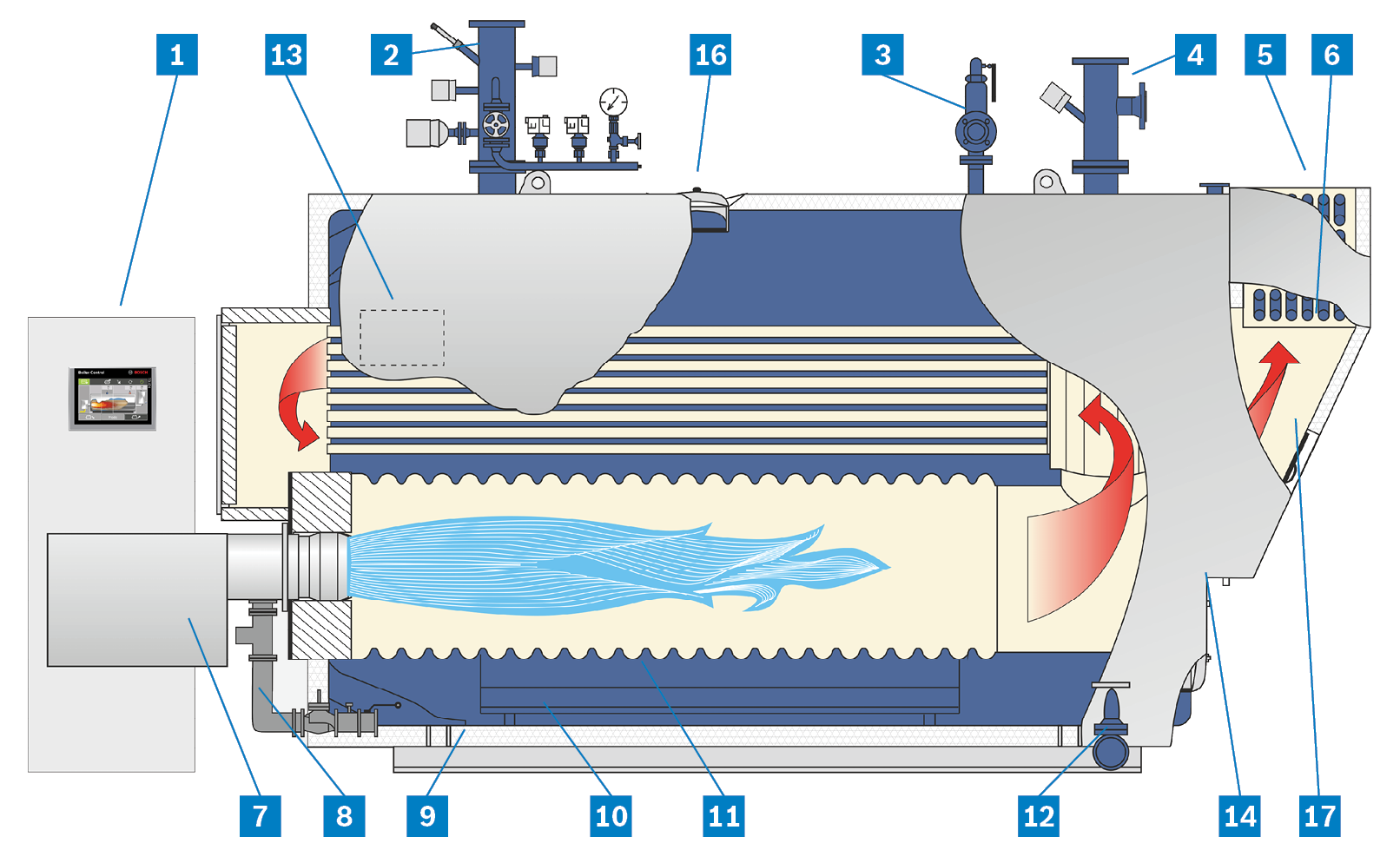
UT-HZ three-pass shell boiler
|
|
Control panel with BCO boiler control system |
|
|
Supply flow adapter piece with
|
|
|
Full-lift safety valve |
|
|
Return flow adapter piece
|
|
|
ECO flue gas heat exchanger |
|
|
Flue gas collection chamber |
|
|
Burner |
|
|
Gas regulation module |
|
|
Base frame |
|
|
Insulation with protective casing |
|
|
Water circulation guiding profiles |
|
|
Drain shut-off valve, maintenance-free |
|
|
Terminal box |
|
|
Sight hole |
|
|
Inspection opening, water side |
|
|
Inspection opening, flue gas side |

This variation on the three-pass boiler design can be used both as a heating boiler operating at a pressure of less than 0.5 bar (110 °C) and as a hot water boiler operating at a pressure of up to 16 bar (190 °C). The current state of the art is three-pass boilers, often with an integrated condensing heat exchanger for heating applications. The compact design of Bosch heating and hot water boilers allows for the smallest possible water volume, ensuring rapid heating from a cold start and high operational efficiency. Furthermore, the minimum inlet temperature of 50 °C into the boiler improves efficiency.
The UT-M series are hot water boilers designed for overpressure firing systems in accordance with the TRD 100-300, 503 testing standard. The boilers are designed to produce high-pressure hot water at a maximum temperature of 190 °C (the cut-off temperature of the safety temperature limiter) for heating systems that comply with the requirements of DIN EN 12953.
The UT-L series are boilers designed for overpressure firing systems in accordance with DIN EN 303. The boilers are designed to produce low-pressure hot water at a maximum temperature of 110 °C (the cut-off temperature of the safety temperature limiter) for heating systems that comply with the requirements of DIN EN 12828.
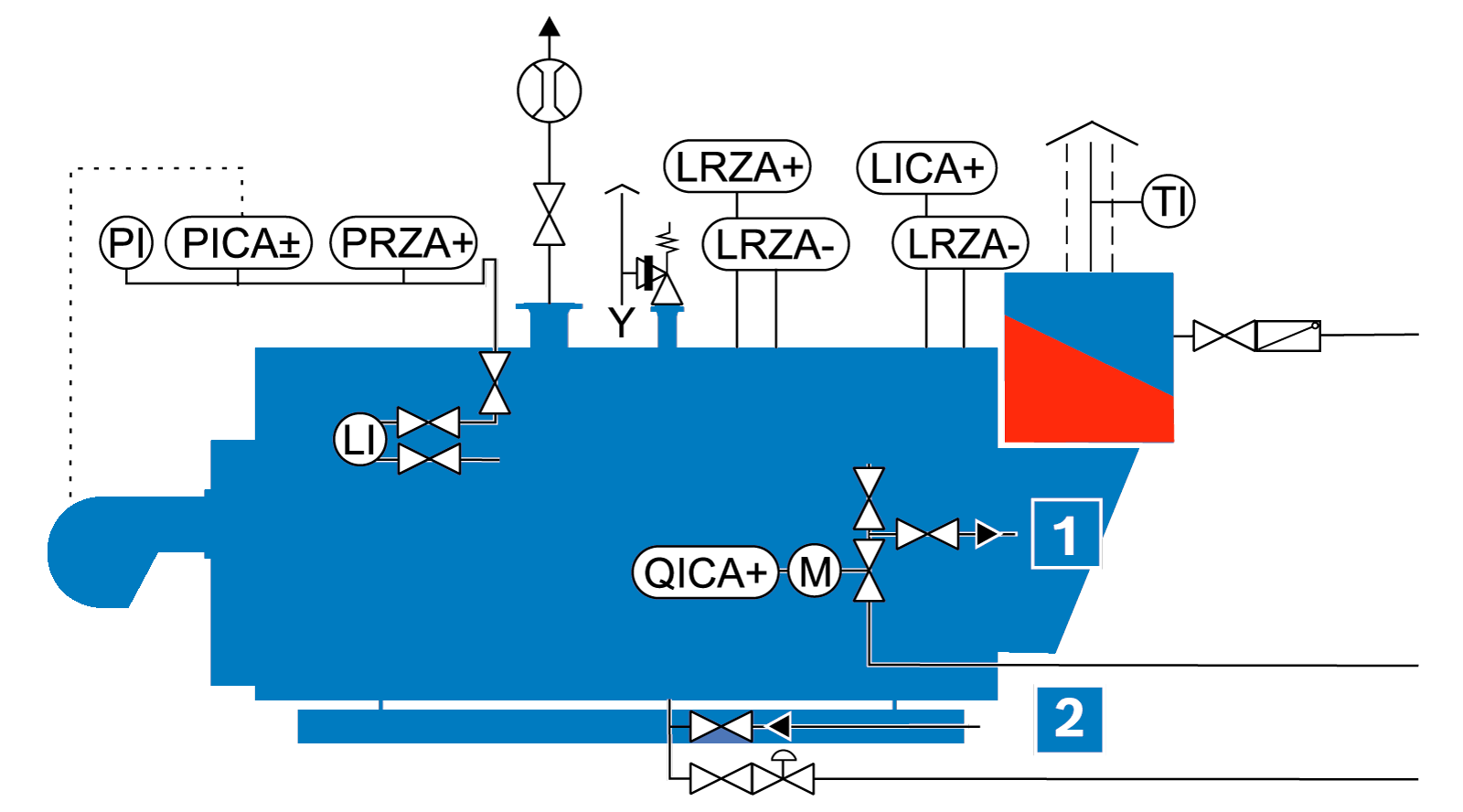
UNIMAT UT-L heating boiler
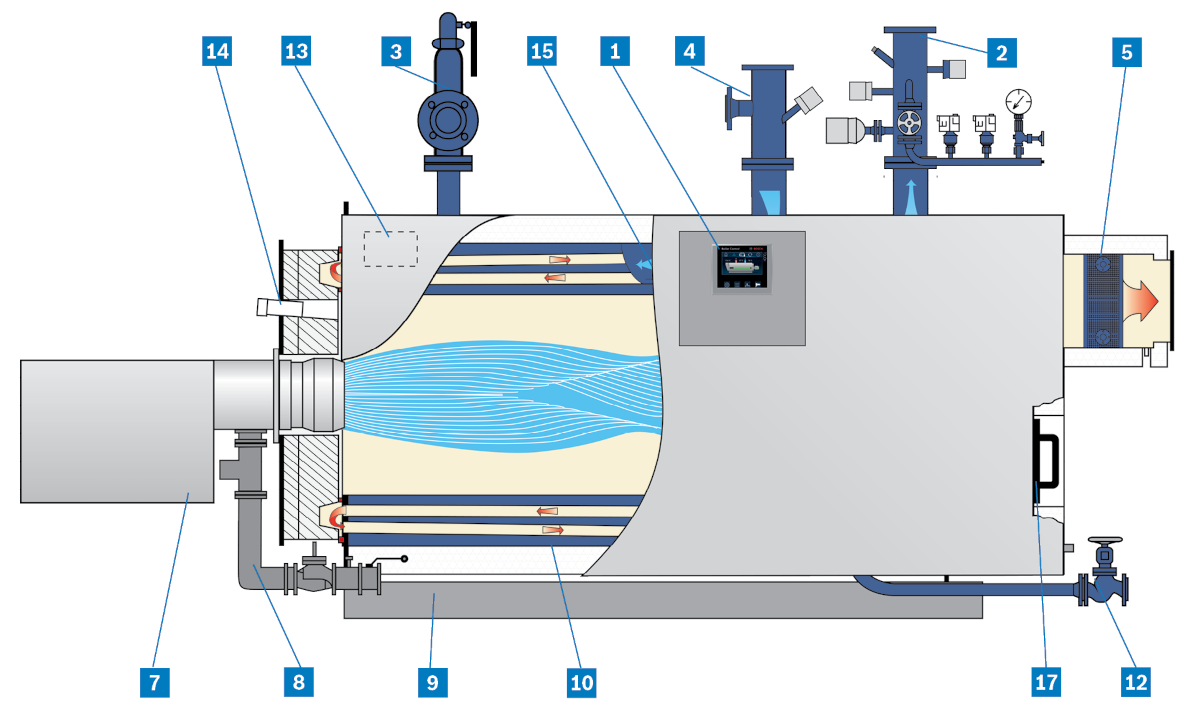
UNIMAT UT-L heating boiler
|
|
Control panel with compact CWC hot water boiler control system or BCO boiler control system |
|
|
Supply flow adapter piece with
|
|
|
Full-lift safety valve |
|
|
Return flow adapter piece
|
|
|
ECO flue gas heat exchanger – alternatively, the flue gas connection can also be fitted at the side or at the top |
|
|
Burner |
|
|
Gas regulation module |
|
|
Base frame |
|
|
Insulation with protective casing |
|
|
Drain shut-off valve, maintenance-free |
|
|
Terminal box |
|
|
Sight hole |
|
|
Injector device for internal temperature increase |
|
|
Inspection opening, water side |
|
|
Inspection opening, flue gas side |
Electric heating and hot water boilers
Electric hot water boilers use electrical energy to heat water efficiently and are used in various sectors, such as building technology, district heating and industrial processes. They operate on the power-to-heat principle, whereby electricity is converted directly into heat, and achieve an efficiency of up to 99.6 %. They are becoming increasingly important, particularly in the context of the energy transition, as they can convert surplus electricity from renewable sources, such as wind and solar power, into usable heat.
One of the major advantages of electric heating and hot water boilers is that they are environmentally friendly. As no fossil fuels are burned, there are no CO₂ or NOₓ emissions. This makes it an attractive solution for companies that are committed to low-emission technologies. Their compact design, combined with the fact that they do not require flue systems or fuel stores, means they take up very little space.
In addition, these boilers offer a high degree of flexibility thanks to the control system’s rapid response. This makes them ideal for balancing out peak loads in the electricity grid. They are therefore particularly well suited to applications requiring variable heat output, or as an expansion for renewable energy sources.
Typical applications include heating large buildings, integration into district heating networks, and the provision of process heat in industrial plants. Electric heat generators help to decarbonise the heating supply and offer a future-proof, environmentally friendly alternative to conventional heat generators.
The design of the electric boiler allows it to be used both as a heating boiler at a pressure of less than 0.5 bar and as a hot water boiler at a pressure of up to 16 bar.
The boiler shells for the heating and hot water boilers are designed and manufactured in accordance with EN 12953. The safety technology and equipment for the boiler system are selected according to the specific application:
- Production of hot water at a maximum temperature of 110 °C (cut-off temperature of the safety temperature limiter) for heating systems that comply with the requirements of DIN EN 12828.
- Production of high-pressure hot water at a maximum temperature of 190 °C (cut-off temperature of the safety temperature limiter) for heating systems that comply with the requirements of DIN EN 12953.
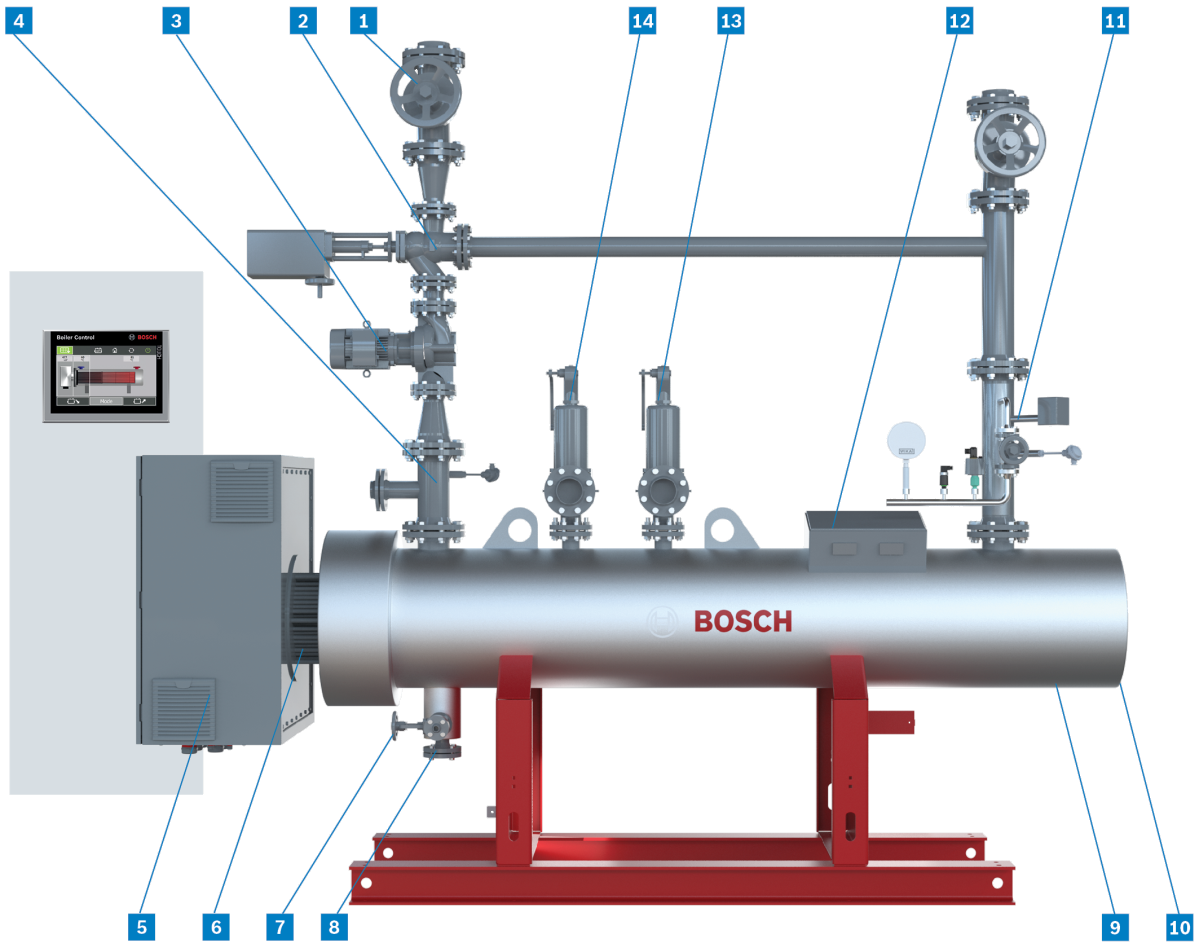
Bosch Electric boiler for heating and hot water ELHB
|
|
Shut-off valve |
|
|
3-port valve |
|
|
Variable-speed pump |
|
|
Return flow adapter piece |
|
|
Terminal box |
|
|
Heating bundle |
|
|
Dirt trap |
|
|
Drain with shut-off valve |
|
|
Insulation |
|
|
Inspection opening |
|
|
Supply flow adapter piece with:
|
|
|
Terminal box |
|
|
Full-lift safety valve |
|
|
Full-lift safety valve 2 (optional) |
Water-tube boilers are a type of steam or hot water boiler in which water is guided through tubes that are heated from the outside by flue gases. This design allows for high operating pressures and temperatures, making it particularly suitable for industrial applications and power stations. The main difference between water-tube boilers and shell boilers lies in their lower water content and their ability to respond more quickly to changes in load.
Water-tube boilers are used in the high-megawatt range, where shell boilers cannot be used due to their design. They are therefore often used where there is a very high demand for steam or heat (> 100 t/h / 63 MW) and at very high pressures (> 32 bar). These boilers are also frequently used for the combustion of solid fuels, such as waste, biomass or coal.
The construction is significantly more complex, and the water treatment process is also more extensive than in shell boilers. Due to their complexity and the higher pressure level, they require more extensive maintenance and skilled operation, and are usually built and installed on site because of their size.
Boiler with waste heat recovery
Special designs for using waste heat to generate hot water include the so-called four-pass boiler or the dedicated heat recovery boiler. In a four-pass boiler, part of the third flue tube is used as a separate pass for the passage of hot flue gases and contributes up to 15 % of the supplied energy. In a pure heat recovery boiler, there is no burner at all. It derives all of its energy from hot flue gases (e.g. from combined heat and power units or gas turbines).
Hot water extraction from steam boilers for low heat outputs
Extraction of hot water from an existing steam boiler
|
|
Hot water, flow |
|
|
Hot water, return |
In certain cases, an existing hot water demand can also be met by drawing water from an existing steam boiler. The heat demand of the closed hot water circuit should not exceed 10 % of the steam boiler’s rated output. The steam chamber in the boiler is used here to maintain pressure (cf. expansion vessels in heating systems).
Determining the boiler dimensions:
The sum of the heat output on the steam side + the heat output on the hot water side- Comparison with the maximum heat output of a steam boiler
- The maximum permissible heat output must not be exceeded when hot water and steam are being drawn off simultaneously.
-
Example:
Steam output: 5,000 kg/h (corresponds to a thermal capacity of 2,777 kW)
Hot water output: 250 kW
Total heat output: 3,027 kW - Maximum permissible heat output: 3,186 kW (at an efficiency of 95 %)
Information for designing the system:
- The temperature of the flow water drawn from the hot water side corresponds to the saturated steam temperature at the current working pressure.
- In the design scenario: Flow temperature = saturated steam temperature at the mean working gauge pressure - To ensure the safe operation of the hot water network, it is recommended that the flow temperature be reduced by approximately 25 K.
- Maximum spread on the hot water side: 40 K The hot water network must be designed appropriately for the boiler dimensions.
- The expansion of the hot water network between ambient temperature and SCO temperature must be less than the water content between the LW and HW circuits in the boiler. It is advisable to ensure that the volume of the hot water network is kept as low as possible.
-
If the size of the hot water network is unknown, the expansion volume must be accommodated by separate devices.
Calculation of the volume between low water (LW) and high water (HW) - Additional equipment and safety devices are required for the technical implementation. An additional quick-closing device must be provided in the steam supply system to limit the minimum pressure level of the hot water system. For hot water extraction, supply and return connections must also be installed below the water level. As a rule, the hot water circuit is operated with a reduced flow temperature, as the required temperature is below the boiling point at the pressure present in the steam boiler. The hot water circuit must be protected separately by a second minimum and maximum pressure limiter. A circuit pump is required for transporting the medium. In comparison to steam, larger pipe cross-sections are required in relation to the rated output.
Hot water extraction from steam boilers for high heat outputs
The hot water is extracted via supply and return connections installed specifically for this purpose in the water chamber of the steam boiler.
Determining the boiler dimensions:
The sum of the heat output on the steam side + the heat output on the hot water side- Comparison with the maximum heat output of a steam boiler
- The maximum permissible heat output must not be exceeded when hot water and steam are being drawn off simultaneously
-
Example:
Steam output: 5,000 kg/h (corresponds to a thermal capacity of 2,777 kW)
Hot water output: 2,000 kW
Total heat output: 4,777 kW
Maximum permissible heat output: 5,028 kW (at an efficiency of 95 %), corresponding to boiler dimensions UL-S 10,000.
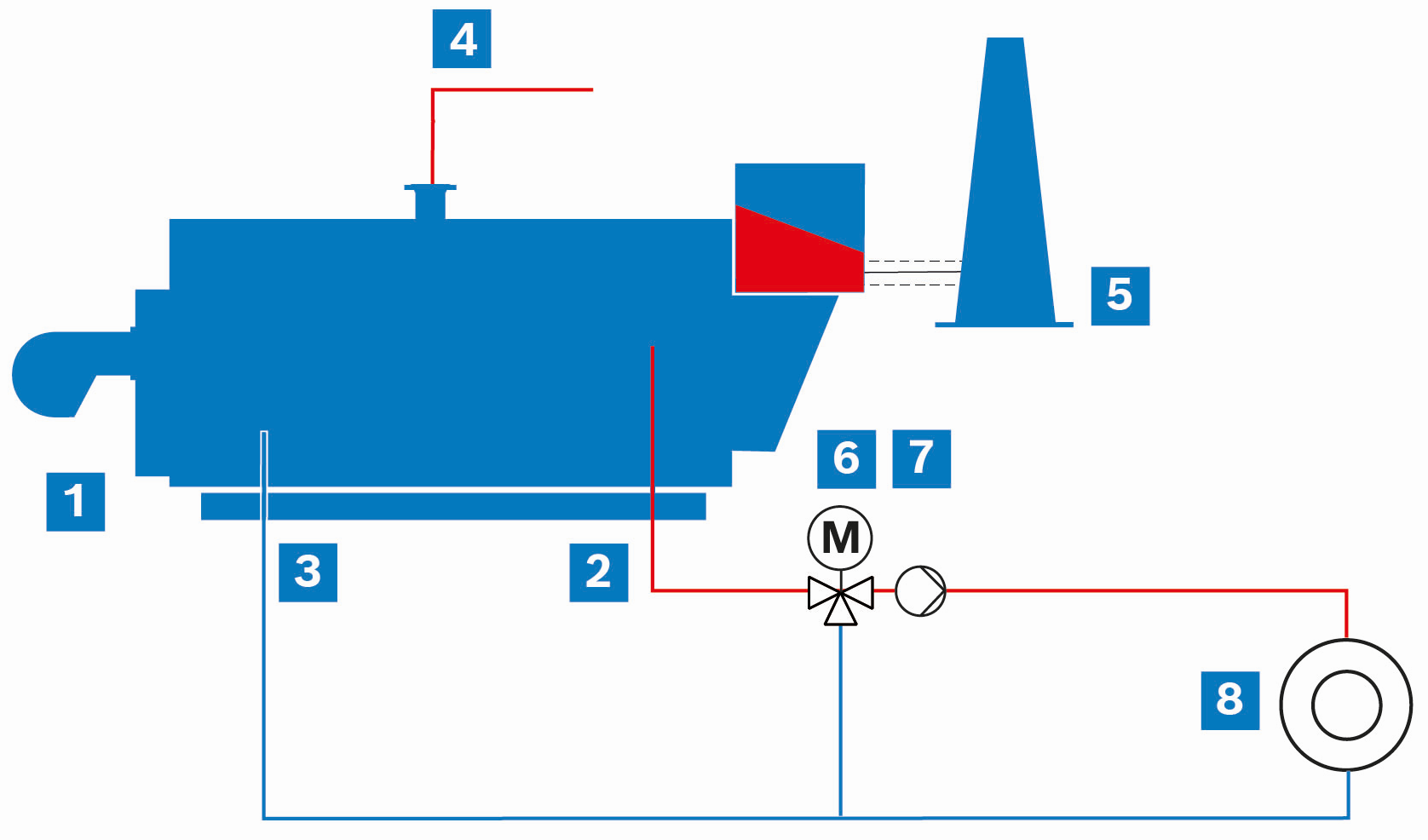
Diagram of hot water extraction from a steam boiler
|
|
Steam boiler |
|
|
Flow |
|
|
Return |
|
|
Steam consumer |
|
|
Chimney |
|
|
Three-way valve for the flow temperature control |
|
|
Mains-powered circulation pump |
|
|
Heat consumers for hot water |
Retrofitting from steam boilers to hot water
In general, there is a high degree of technical similarity between steam and hot water boilers, due to the similarities in their safety equipment and their similar temperature/pressure ranges. Three key design differences are the need for a steam chamber in steam boilers, the significantly larger pipe cross-sections relative to the thermal output in hot water systems, and the need for a hot water return connection of the same diameter as the flow connection. When retrofitting a steam boiler to hot water, the steam chamber is inevitably filled with water during operation, resulting in an unnecessarily large volume of water, which increases the system’s inertia and, for example, the time taken to heat up from a cold start.
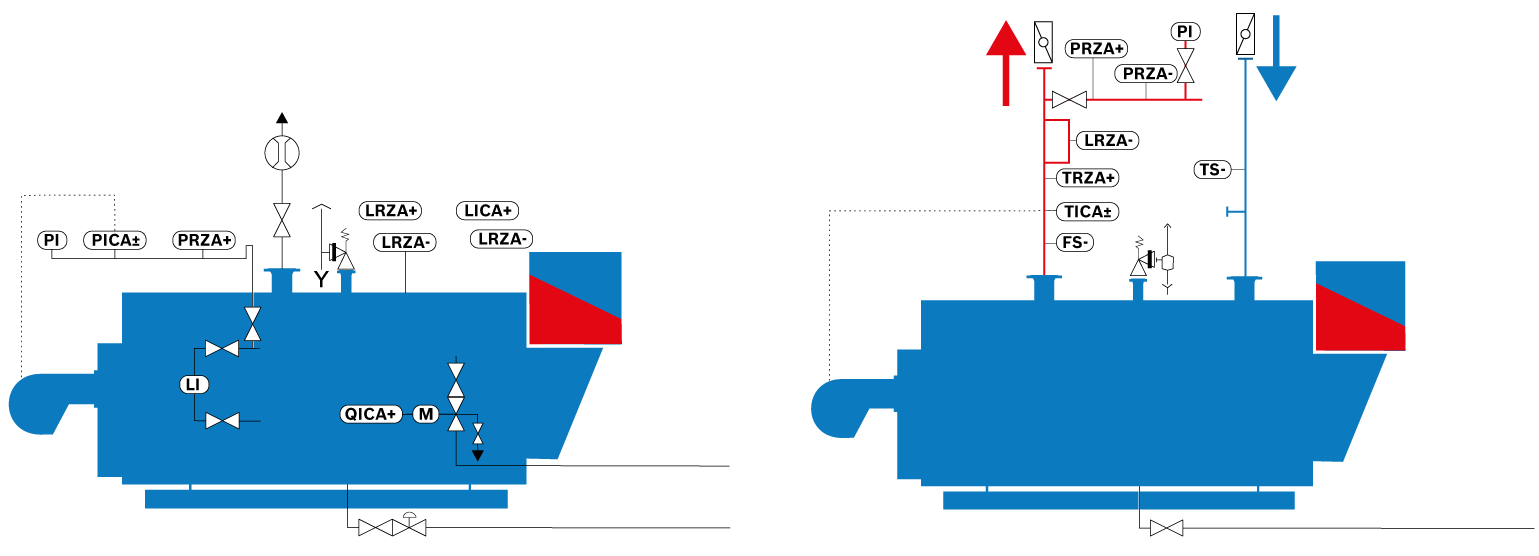
Comparison of equipment for steam boilers and steam boilers for hot water extraction
If a steam boiler is designed from the outset to be subsequently retrofitted to hot water, additional connections, etc.must also be provided, which in themselves make the boiler more expensive. However, these costs are still significantly lower than retrofitting the system, which would involve work on the pressure vessel. When operating with hot water, the spread between the flow and return must also be regulated to within the permissible range, and a guide plate must be installed in the boiler. When retrofitting, the control panel, including safety devices, must always be replaced or modified: In addition to implementing the return flow temperature boosting, the boiler circuit pump, amongst other things, must be integrated. Components of the water treatment system, such as the feed water tanks and degassing unit, may be omitted.
In practice, retrofittings from steam to hot water are rather rare. Even more common is the flexible design supplied ex works, particularly for rental boiler systems and containerised systems, where it is clear from the outset that they will be used in a variety of applications. In this case, the advantages of flexibility outweigh the disadvantages in terms of functionality and the higher initial costs.