
Increased efficiency on the water side
Heating and hot water boilers are central components of industrial and commercial systems. They are mainly used to heat water to high temperatures in order to provide heat for various processes or heating purposes. A decisive factor for the efficiency of a hot water boiler is the temperature differential between the water flowing into and out of the boiler or heat exchanger. This temperature differential plays an important role in optimising energy consumption and the overall efficiency of the system. The greater the temperature differential for the same amount of heat, the lower the required volume flow.
Increased thermal efficiency
The temperature differential in a heating and hot water boiler is the difference between the cold temperature of the boiler return entering the boiler and the warmer temperature of the boiler flow leaving the boiler. Optimal boiler operation is achieved when this temperature differential is designed to minimise overall energy consumption.
In most systems, the flow temperature is a fixed value specified by the application, which may vary depending on the season, especially in heating applications, depending on the outside temperature.
The return temperature is the temperature that may be influenced by heat consumers. A greater temperature differential means that the return temperature is cooler and therefore more heat is extracted from the heating process.
The higher temperature differential means that the boiler operates more efficiently, as more heat is transferred to the water in relation to the volume flow. The thermal efficiency of the boiler is increased, reducing fuel consumption and therefore the running costs. Increasing the temperature difference from 20 K to 30 K improves thermal efficiency by up to 0.5 %.
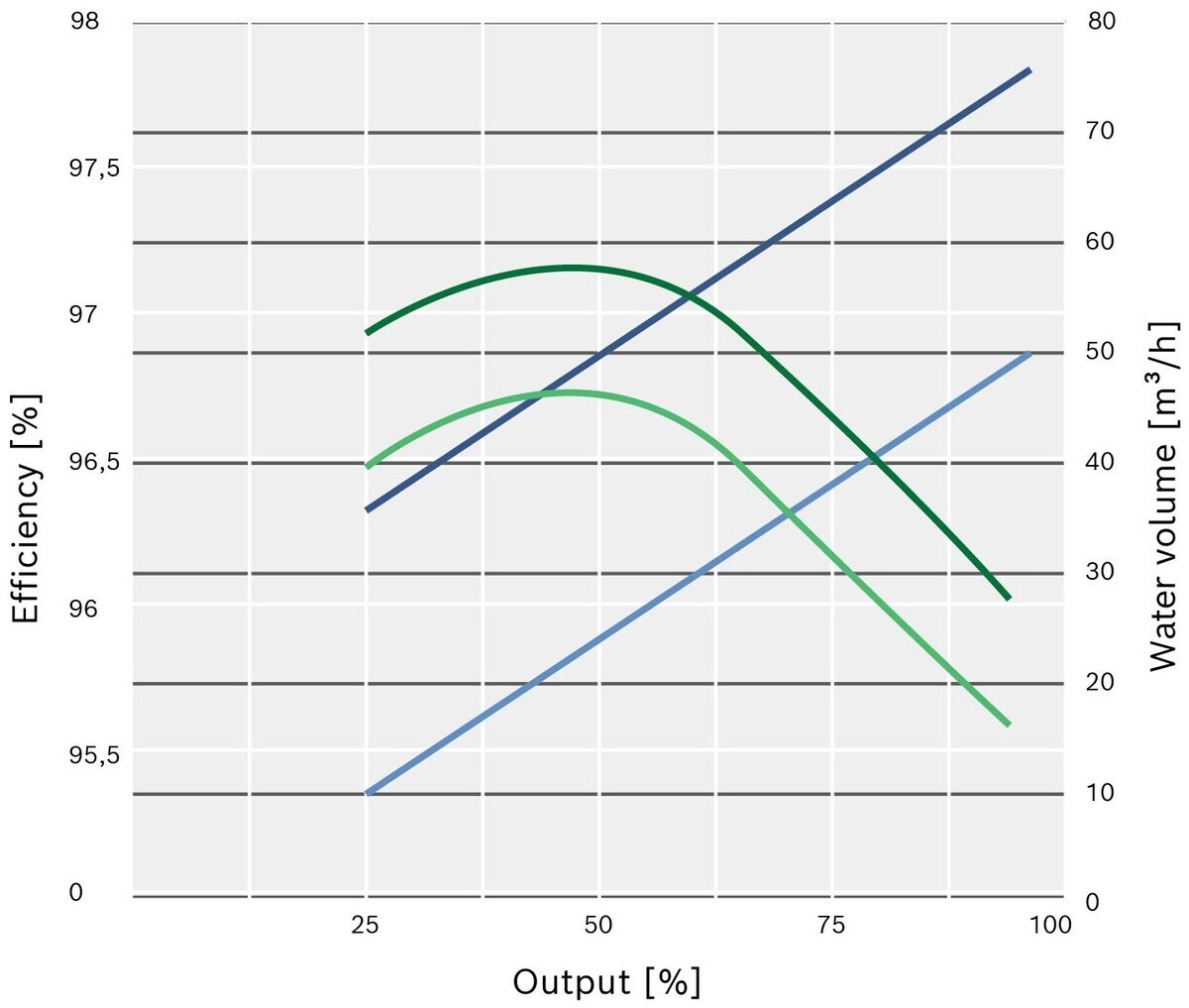
Relationship between efficiency, output and water content using the example of a 1,700 kW hot water boiler
|
|
Efficiency with a temperature difference of 30 K between the flow and return |
|
|
Efficiency with a temperature difference of 20 K between the flow and return |
|
|
Water volume with a temperature difference of 30 K between the flow and return |
|
|
Water volume with a temperature difference of 20 K between the flow and return |


