
Connection of electrically heated boilers
The requirements for connecting electrically heated boilers are set out below; this is intended to serve as a guide for the work to be prepared and carried out on site.
At the same time, these points set out the interfaces included in the Bosch scope of delivery, unless deviations specific to the order have been agreed. In summary: All relevant national and local regulations, as well as the applicable standards, must be complied with.
Overview of the main components
The main components of the electric boiler system include the power cabinet, the boiler control panel and the terminal boxes. Each of these components has specific requirements in terms of dimensions, protection ratings and short-circuit resistance. The width of the control panel varies depending on the connected power and voltage, which must be taken into account during the planning stage.
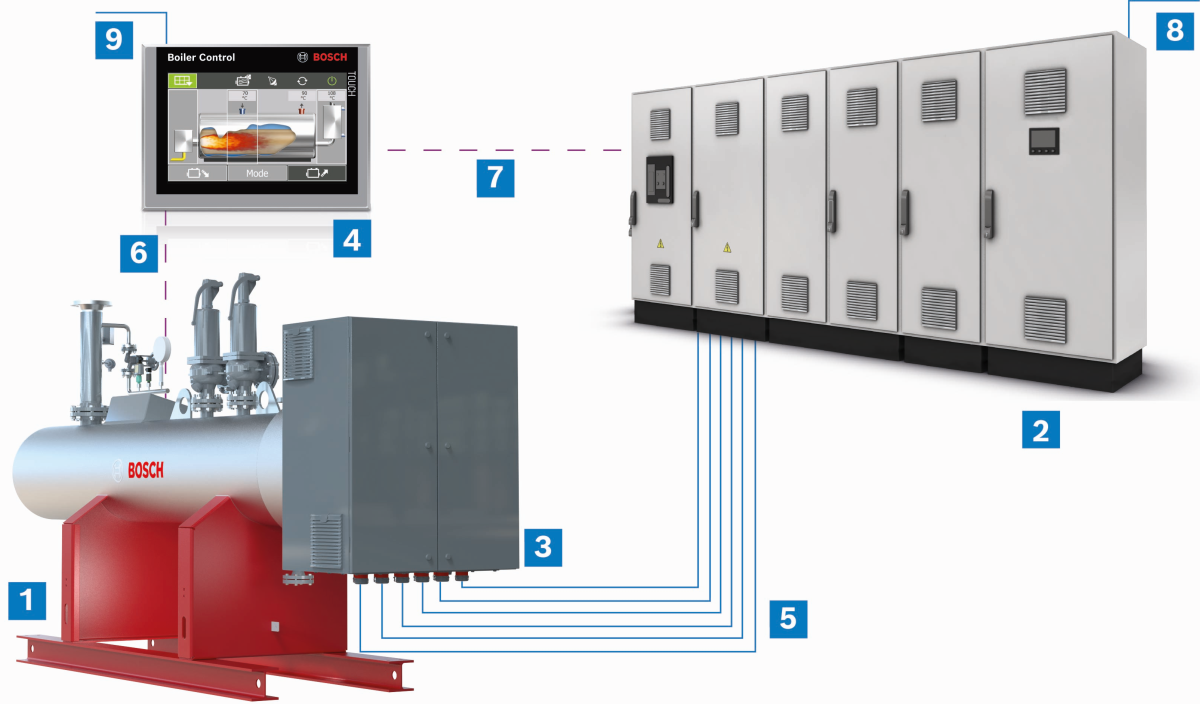
ELHB electric hot water boiler with connection cables to the power cabinet and boiler control system (schematic diagram)
|
|
Electric hot water boiler |
|
|
|
Power cabinet |
|
|
|
Terminal box |
|
|
|
BCO boiler control |
|
|
|
Power cable |
|
|
|
Connection between the boiler and the boiler control system |
|
|
|
Connection between the boiler control system and the power cabinet |
|
|
|
Power cabinet supply |
|
|
|
Boiler control supply system |
|
|
|
Bosch options |
|
|
|
On-site |
|


Cable connections and dimensioning
The dimensioning of the cable connections between the main components must be carried out on-site and must comply with the relevant local regulations. It is important that the cable routes and cable ducts are approved and suitable in order to prevent interference. When routing the cables, the minimum bending radii and cable spacing requirements for each cable type must be observed in order to prevent damage and ensure proper functionality. You must observe the maximum cable length (where specified) and ensure that the cables are protected from direct sunlight.
Earthing and potential equalisation
Earthing and potential equalisation are essential for protection against electric shock and must be carried out in accordance with IEC 60364-4-41 (installation of low-voltage systems). It must be ensured that the earthing measures are mechanically secure and corrosion-resistant. In addition, the connection between the boiler and the base frame should be made via a conductive link to ensure that the boiler system is at the same earth potential for safety reasons.
Environmental conditions
The permissible ambient temperatures for the installation of the standard version of the boiler systems are set at between +10 °C and +35 °C. In the event of higher temperatures or specific requirements, additional measures, such as the installation of air-conditioning units, must be considered. These devices must also be connected to a separate power supply on-site.
Load control
The load control of the electrically powered boilers is preset so that the load range from 0 to 100 % can be ramped up or down in a minimum of 120 seconds. This regulation is important for the safe operation of the boilers. A reduction in load control can be implemented on a project-by-project basis following consultation with Bosch. It should be noted, however, that safety-related shutdowns may lead to a sudden drop in load, which cannot be predicted and may have adverse effects on the supply network.