
Air preheating
Air preheating is used in boiler systems to save fuel and increases efficiency by up to 1.8 %.
Air preheating requires two heat exchangers in the flue system. In the first stage, the flue gas temperature is already cooled to around 130 °C by the return . Secondly, a separate heating circuit is set up for air preheating, allowing the flue gas temperature to be reduced to 80 °C. At return temperatures of < 80 °C, the amount of heat recovered in the first flue gas heat exchanger is already so high that the flue gas temperature drops below 110 °C. It is therefore essential to carry out a thorough economic analysis of the efficiency of preheating.
Air preheating is only effective within a flue gas temperature range of 130 – 110 °C downstream of the first flue gas heat exchanger. Higher flue gas temperatures result in higher water inlet temperatures (risk of the combustion plant shutting down due to the maximum air outlet temperature being reached). Lower flue gas temperatures result in lower water inlet temperatures (risk of corrosion due to temperatures falling below the dew point). This ensures that the temperature of the carrier medium in the air preheating circuit remains between 65 and 90 °C. In principle, this system can also be adapted to higher flue gas temperatures and temperatures in the water circuit. Burners that are suitable for higher air temperatures must be used for this purpose.
In a heat exchanger used to preheat the combustion air, the heat extracted from the flue gas is transferred to the combustion air.
When choosing a fuel, you should pay attention to its sulphur content. From this perspective, the use of air preheating is not suitable for heavy fuel oil, as its sulphur content is greater than 0.2 %, which leads to the formation of corrosive sulphuric acid in the flue gas.
In 99 % of cases, air preheating is not a viable option when compared with a flue gas heat exchanger integrated into the boiler circuit in terms of efficiency gains and investment costs; however, it does represent a potential means of improving efficiency. The efficiency gain of up to 1.8 % is often exceeded simply by using a standard flue gas heat exchanger. Higher investment costs arise from the use of a required duoblock burner, which also results in higher installation and operating costs.
In addition, emissions are increased by air preheating; in such cases, larger boilers or external flue gas recirculation are required to comply with emission limits.
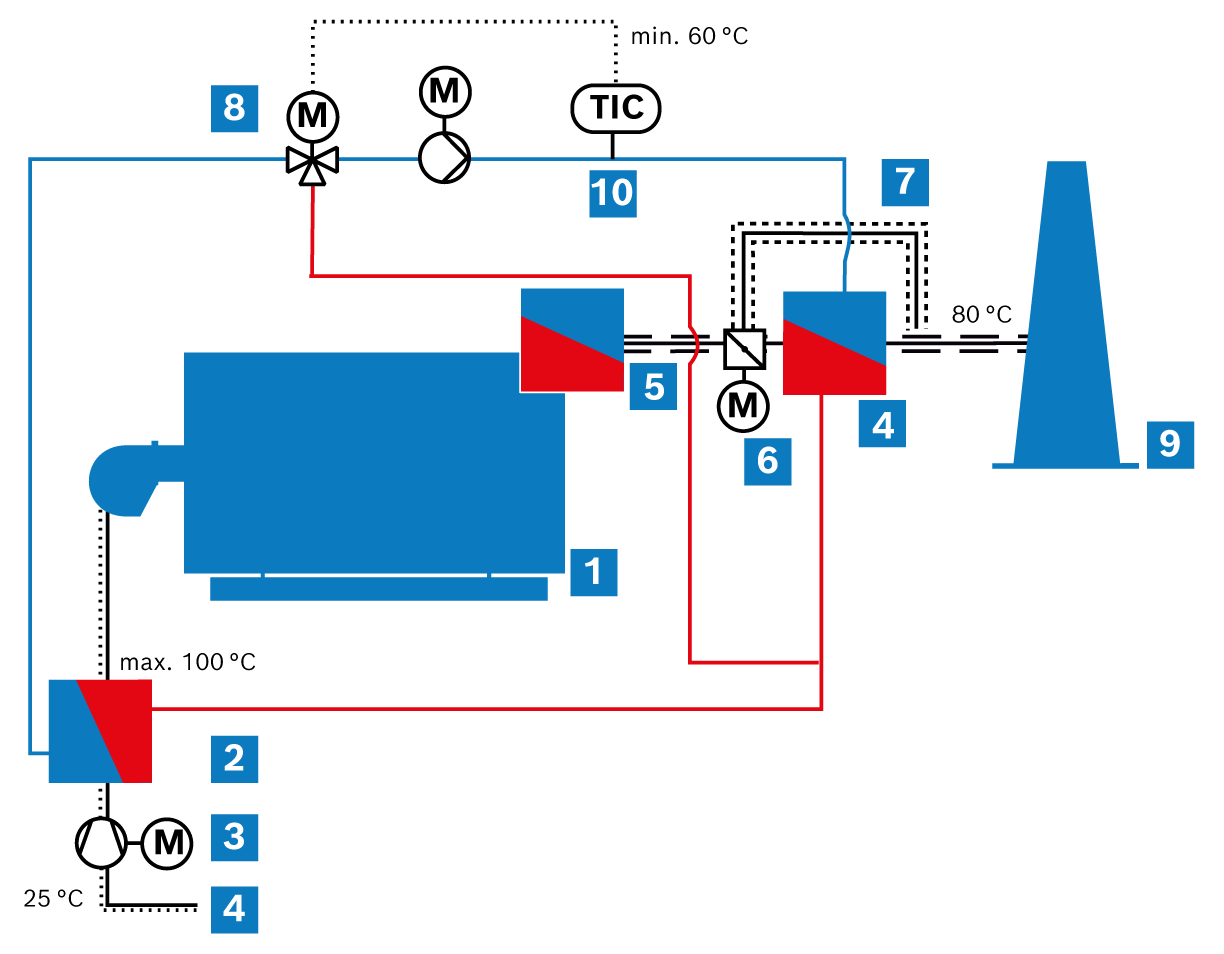
How an air preheater works in a hot water boiler system (simplified diagram); a bypass is required for oil-fired operation
|
|
Hot water boiler |
|
|
Heat exchanger, air side |
|
|
Fan |
|
|
Combustion air |
|
|
Flue gas heat exchanger |


|
|
Flue gas control valve |
|
|
Bypass |
|
|
Three-way control valve |
|
|
Chimney |
|
|
Temperature controller |


