
Flue gas heat exchanger
Flue gas heat exchangers are now standard equipment in industrial boiler plants. Nowadays, heating and hot water boilers are fitted with a flue gas heat exchanger to improve efficiency and reduce fuel consumption. The flue gas heat exchanger can be designed as an integrated unit or as a standalone variant. Various designs are available to ensure that flue gas heat exchangers operate in a manner optimised for each individual plant. A key difference in their application lies in the use of condensing technology in the flue gas heat exchanger.
In the flue gas heat exchanger, heat is recovered from the hotter boiler flue gases by passing cooler return water through the heat exchanger tubes, thereby reducing the flue gas temperature. The energy recovered in this way increases the boiler efficiency, thereby reducing both fuel consumption and flue gas emissions.
The flue gas stream emerging from the heating and hot water boiler still has a temperature of 200 – 280 °C. The flue gas heat exchanger utilises this high-temperature thermal energy, with its highly efficient downstream heating surfaces, to recover heat from the dry flue gas. The heat recovered from the flue gas is usually fed into the boiler circuit or a secondary circuit, thereby improving the boiler efficiency.
When using gas and low-sulphur fuel oil, the aim should be to ensure that the water inlet temperature at the condensing flue gas heat exchanger is as low as possible. The aim is to deliberately operate the system in a humid environment (flue gas condensation) in order to achieve a further increase in efficiency. When operating the flue gas heat exchanger with fuel oil (not low-sulphur grade), ensure that the minimum water inlet temperature at the flue gas heat exchanger is 60 °C in order to protect the flue gas heat exchanger from corrosion caused by the flue gases. With the aid of an optional water-side control system, the water inlet temperature at the flue gas heat exchanger can be raised to the required minimum water inlet temperature during oil operation by mixing in preheated water. If the water inlet temperature cannot be raised to the minimum water inlet temperature, in the case of flue gas heat exchangers with an integrated flue gas bypass operating on oil, the total flue gas flow from the boiler is diverted past the flue gas heat exchanger using the flue gas control valve.
Information about flue gas temperature or flue gas loss
To further improve efficiency, flue gas heat exchangers can be used for flue gas condensation or air preheating.
When selecting a variant for a flue gas heat exchanger, several factors must be taken into account to ensure the long service life, high efficiency and safety of the heating or hot water boiler system.
One aspect is corrosion resistance, as flue gases often contain corrosive acids such as sulphuric acid (H2SO4) and nitric acid (HNO3), which can condense at low temperatures.
Corrosion-resistant materials are essential, particularly when recovering condensation heat from moist flue gases.
Depending on the system’s operating pressure, the materials must be strong enough to withstand both internal and external pressures. Furthermore, flue gases may contain particles that cause abrasion at high flow speeds, which is why the material must also be wear-resistant.
Furthermore, economic considerations play a role: Higher-quality materials are often more expensive, which is why the choice should be made with the cost-benefit ratio in mind. It is important to choose a material that offers the best balance between performance and cost.
Information about the flue gas heat exchanger
Overall, choosing the right type of flue gas heat exchanger is crucial to the longevity and efficiency of the entire system. A comprehensive analysis of the operating conditions and the requirements for the heat exchanger is necessary in order to determine the most suitable material.
Information about the condensing flue gas heat exchanger
Information about air preheaters
The flue gas heat exchanger requires an additional safety valve fitted with a pressure gauge and a venting device if a shut-off device is installed between the boiler and the flue gas heat exchanger. If the heat exchanger is connected to the boiler without a shut-off device, no additional safety equipment needs to be fitted.
Various flue gas heat exchanger designs are available to ensure that flue gas heat exchangers operate in a manner optimised for each individual plant.
Integrated flue gas heat exchanger
One of the key benefits of new boiler systems is the fully integrated flue gas heat exchanger, which is fitted directly onto the boiler. A specially designed heat exchanger bundle, available in various sizes and featuring highly efficient finned tubes, is installed as part of the boiler within the flue gas chamber and comes fully insulated.
Boilers with an integrated flue gas heat exchanger offer significant advantages over conventional boilers with a separate flue gas heat exchanger.- Highly efficient finned tube system that does not fall below the dew point
- Highly efficient smooth-tube system for flue gas condensation
- Integrated in the flue gas chamber on the boiler
- Efficiency gains of up to 7 percentage points
- Assembled in the factory, tested and thermally insulated
- Low space requirement
- No additional foundation
- No on-site assembly
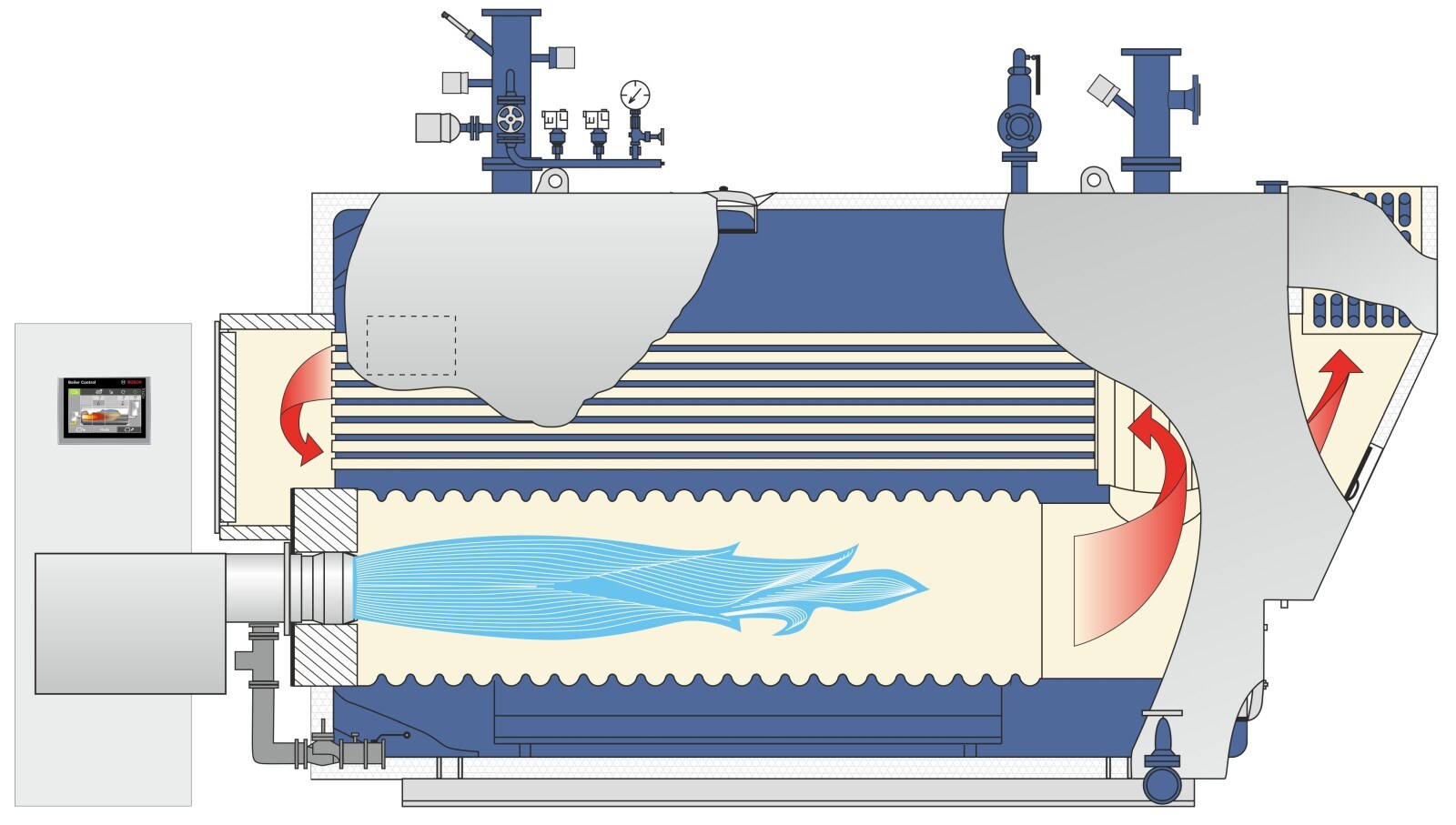
Cross-section of the integrated flue gas heat exchanger on the hot water boiler (UT-HZ)
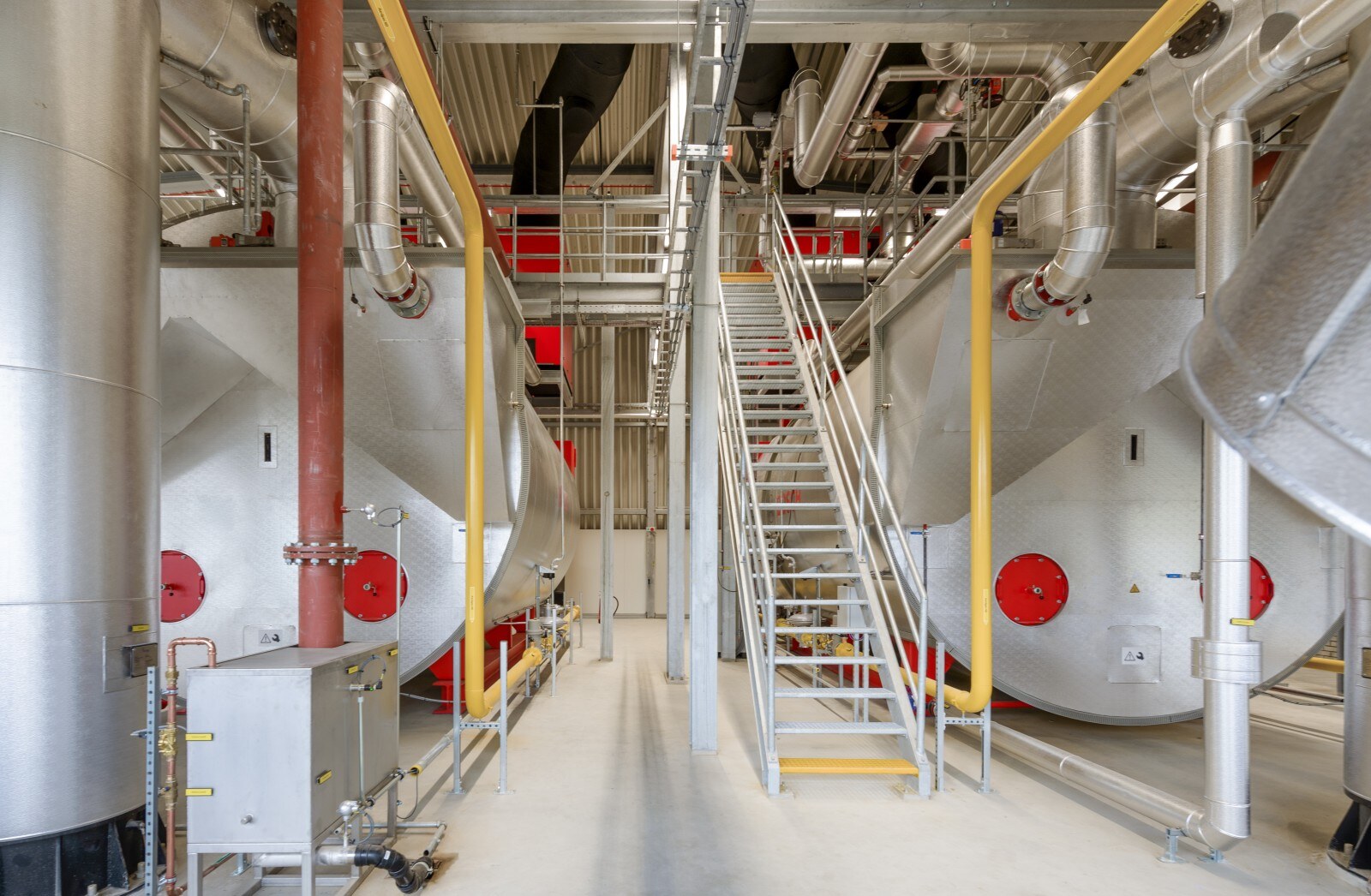
Integrated flue gas heat exchanger on hot water boilers (UT-HZ) in a system
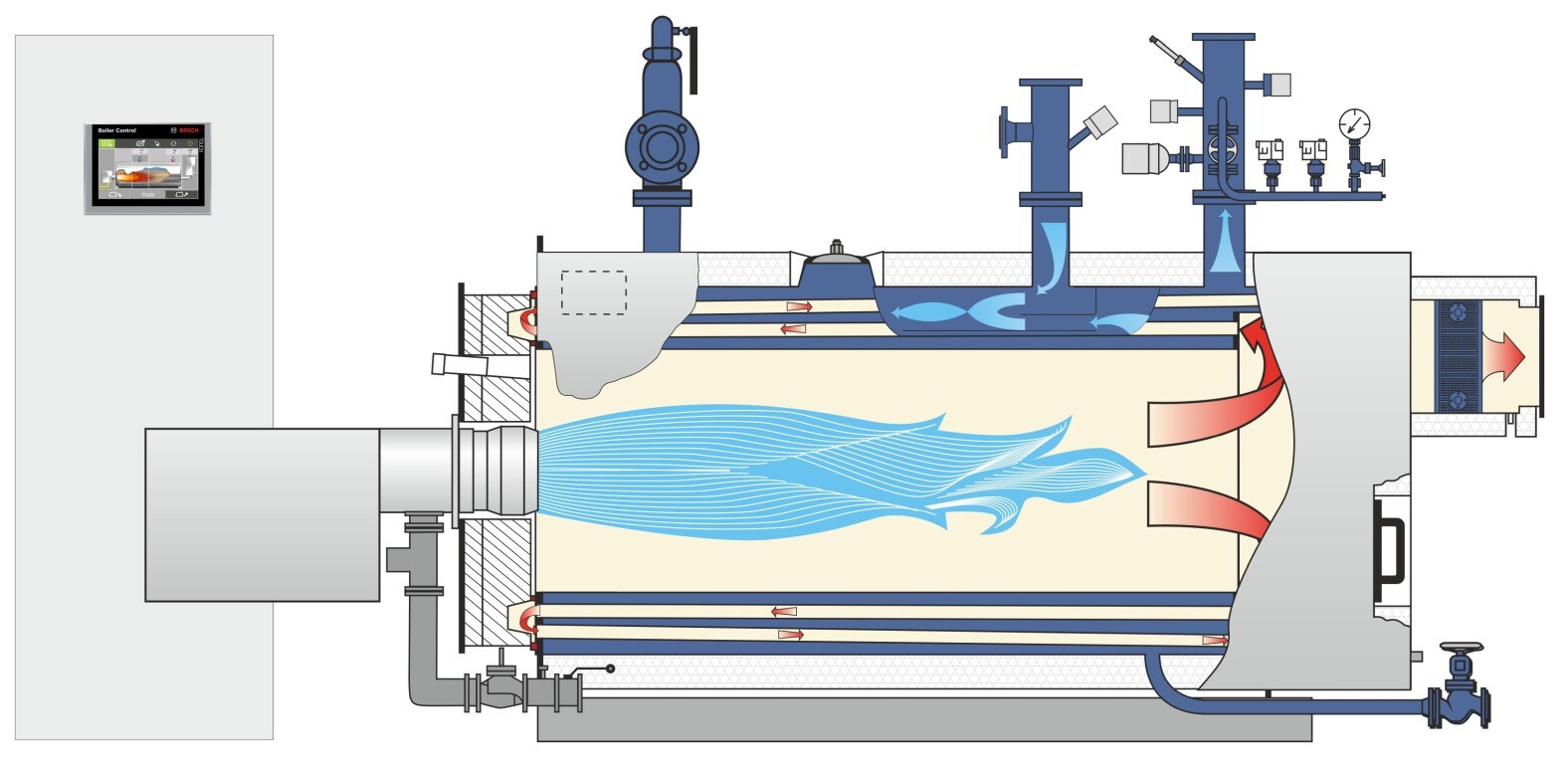
Cross-section of the integrated flue gas heat exchanger on warm- and hot water boilers (UT-L/UT-M)
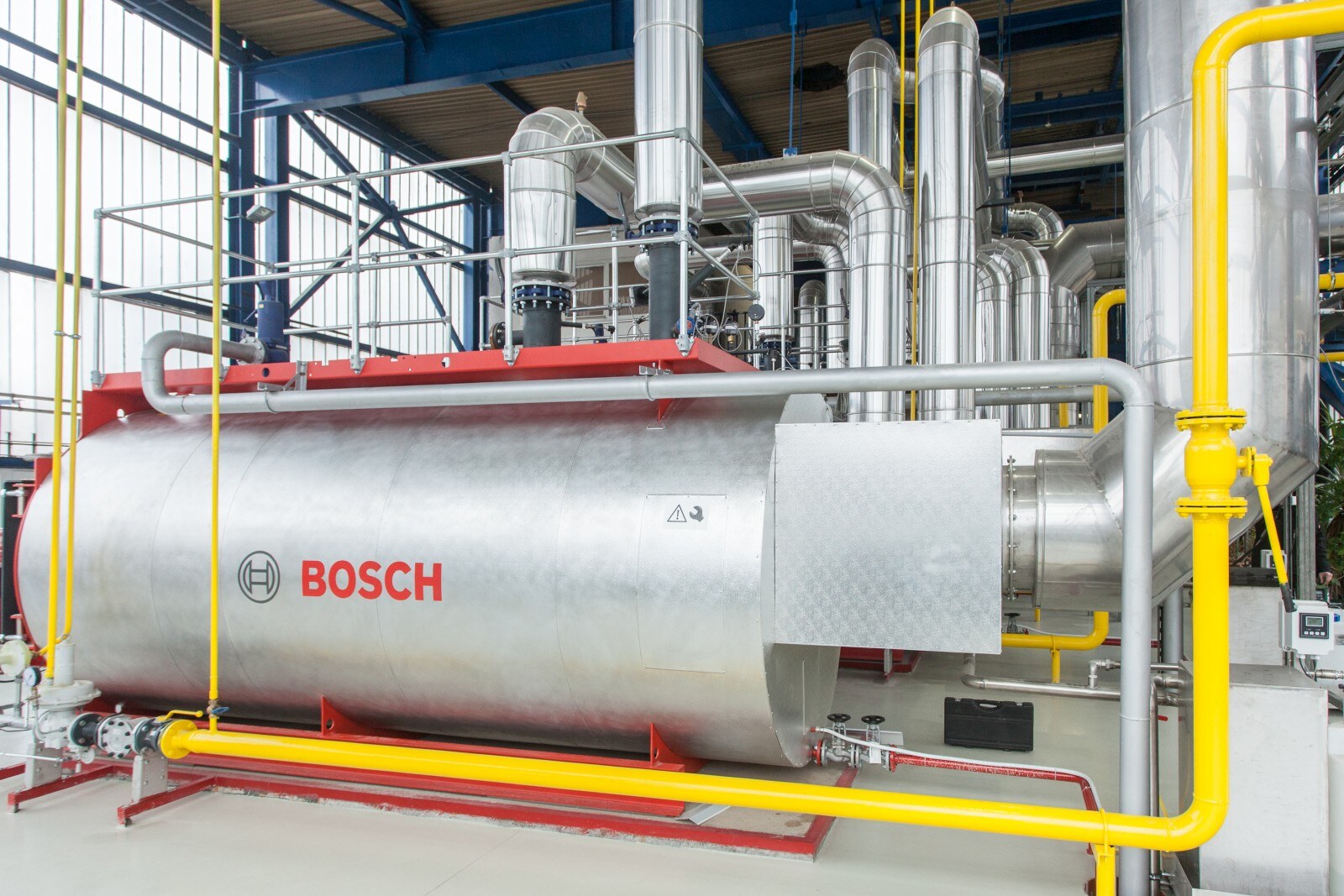
Integrated flue gas heat exchanger on warm- and hot water boilers (UT-L/UT-M) in a system
Stand-alone flue gas heat exchanger
Stand-alone flue gas heat exchangers can be installed separately from the boiler and are therefore particularly suitable for retrofitting existing systems. They are also used when the flue gas heat exchanger needs to be temporarily bypassed on the flue gas side, which is necessary when using sulphur-containing secondary fuels (e.g. heavy fuel oil).
The flue gases enter the front section of the flue gas heat exchanger and flow through the upper section, where the heat exchanger is located for heat recovery. The flue gas bypass, including the motorised flue gas flap, is fully assembled and is included in the scope of delivery ex works, along with thermal insulation.
The stand-alone flue gas heat exchanger is available for all Bosch hot water boilers and heating boilers, as well as for third-party models.
Condensing flue gas heat exchanger
When using condensing technology, not only is the sensible heat directly linked to the temperature extracted from the flue gas, but also some of the heat of condensation bound in the water vapour (latent heat).
This produces acidic flue gas condensate, which must be neutralised. Corrosion-resistant materials are therefore essential in these heat exchangers, the downstream flue gas lines and the chimney.
The self-contained stainless steel flue gas heat exchangers are supplied as ready-to-install modules. They are therefore suitable for both new installations and retrofitting.
The material used for the flue gas line must be heat-resistant to the flue gas temperatures encountered, impervious to moisture and resistant to acidic condensate. Suitable options include stainless steel flue gas lines and other chimneys that are resistant to moisture.