
Buffer cylinder integration
The integration of buffer cylinders into heating and hot water boilers is a key measure for optimising the efficiency and performance of these systems. Buffer cylinders serve as temporary storage for energy and help to better coordinate heat production and consumption. Due to the complexity and wide range of options, only the basics are described below.
How buffer cylinders work- Storage of excess heat
Buffer cylinders store excess heat generated by the heating source (e.g. electric boiler for hot water generation, solar system, CHP units) but which is not currently required. This heat can be used at a later date when demand is higher. At the same time, they ensure reasonable burner running times for fossil-fuel-fired hot water boilers or central heating boilers and prevent unwanted cycling of the combustion process. Heat cylinders are particularly well suited to power-to-heat applications where free or low-cost electricity is available at variable times, as they enable the efficient and cost-effective use of electrical energy. - Hydraulic separation
Buffer cylinders provide a hydraulic separation between the heat generation and the heat consumers. This means that the heat generation can operate independently of the current heat demand. - Temperature stratification
Temperature stratification can occur in a buffer cylinder. This means that the hot water is at the top and the colder water is at the bottom. This stratification increases efficiency, as the hottest water is always drawn off first.
Integration into hot water and heating systems
- Connection to the heat source The buffer cylinder is connected directly to the heat source (e.g. boiler, solar collectors, heat pump). Excess heat is fed into the cylinder if it is not needed immediately
- Connection to the heat consumers
The hot water is fed from the buffer cylinder to the various heat consumers (e.g. building heating, heat exchangers, etc.). The cylinder acts as a buffer to ensure a steady supply of heat tailored to the demand. - Regulation and control
The installation of a buffer cylinder requires suitable regulation and control. Sensors monitor the temperature in the cylinder and the heating circuits to ensure that the heat is distributed as required. Heat is extracted from or added to the cylinder as required.
Advantages of buffer cylinders
- Increased efficiency
By storing excess heat, a hot water boiler or heating boiler can be operated within its optimal efficiency range. Unwanted cycling in conventionally fired heat generators can be reduced. Both reduce fuel consumption and running costs. Another potential benefit of an electric boiler for heating and hot water is the ability to utilise excess electricity, for example from your own photovoltaic system, power purchase agreements (PPAs) with the grid operator, or participation in the spot market. - Flexibility and load management
Buffer cylinders offer flexibility in heat supply by absorbing peak loads and decoupling the heat generation and heat consumption. This is particularly useful in systems with variable heat and fuel sources, such as solar systems or electric boilers for heating and hot water. - Smaller temperature fluctuations
A consistent heat supply improves system performance by reducing temperature fluctuations. Hot water is available at all times, even if the heat generation is temporarily out of service. - Preserving the generator side Reducing the number of times the heat source is switched on and off extends its service life and reduces maintenance requirements.
- Integration of renewable energy
Buffer cylinders allow for the efficient use of various energy sources, such as electric water heaters, combined heat and power (CHP) units, solar thermal systems and biomass, by storing the heat generated and making it available when needed. - Business optimisation
With intelligent energy management, the heat demand can be met in a cost-effective manner, depending on the availability and cost of the energy source (electricity, biogas, natural gas, oil, waste heat, hydrogen).
The integration of buffer cylinders into hot water and heating systems offers numerous benefits, including increased efficiency, flexibility, improved comfort and the ability to integrate renewable energy sources. Buffer cylinders act as temporary storage for excess heat and enable a better balance between heat generation and consumption, resulting in an optimised and more sustainable heat supply.
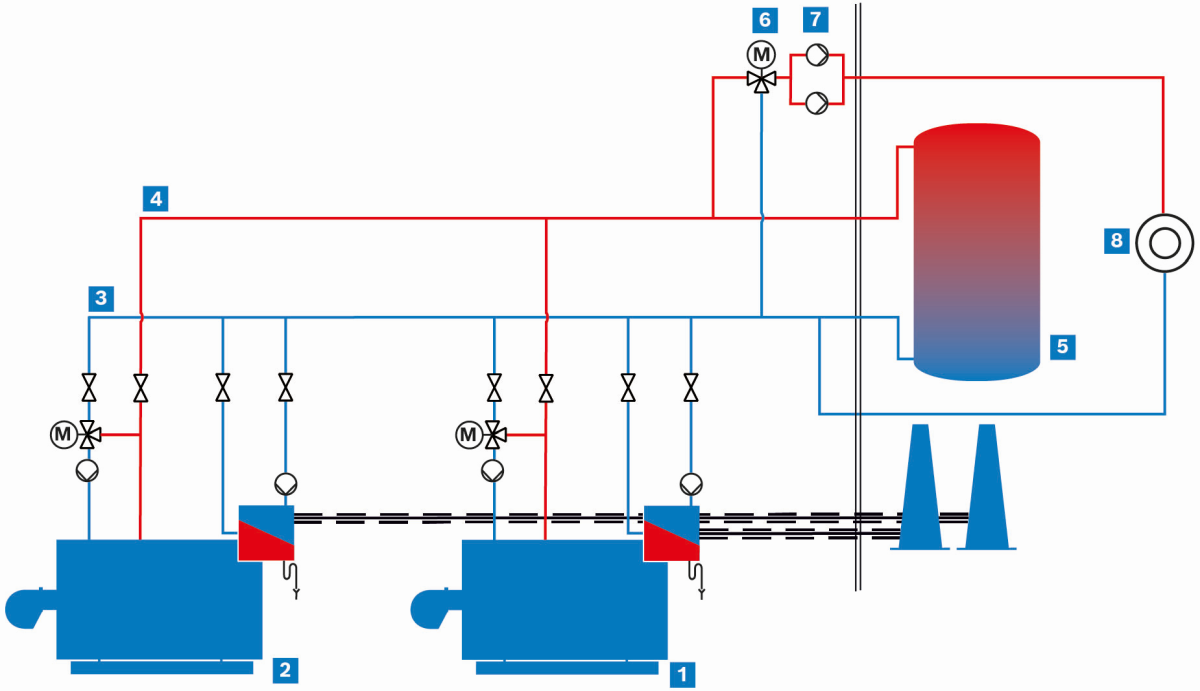
Diagram of a hot water system with a buffer cylinder acting as a hydraulic separator
|
|
Hot water boiler 1 |
|
|
Hot water boiler 2 |
|
|
Return |
|
|
Flow |


|
|
Heat cylinder as hydraulic separation |
|
|
Three-way valve for the flow temperature control |
|
|
Mains-powered circulation pumps |
|
|
Heat consumer |


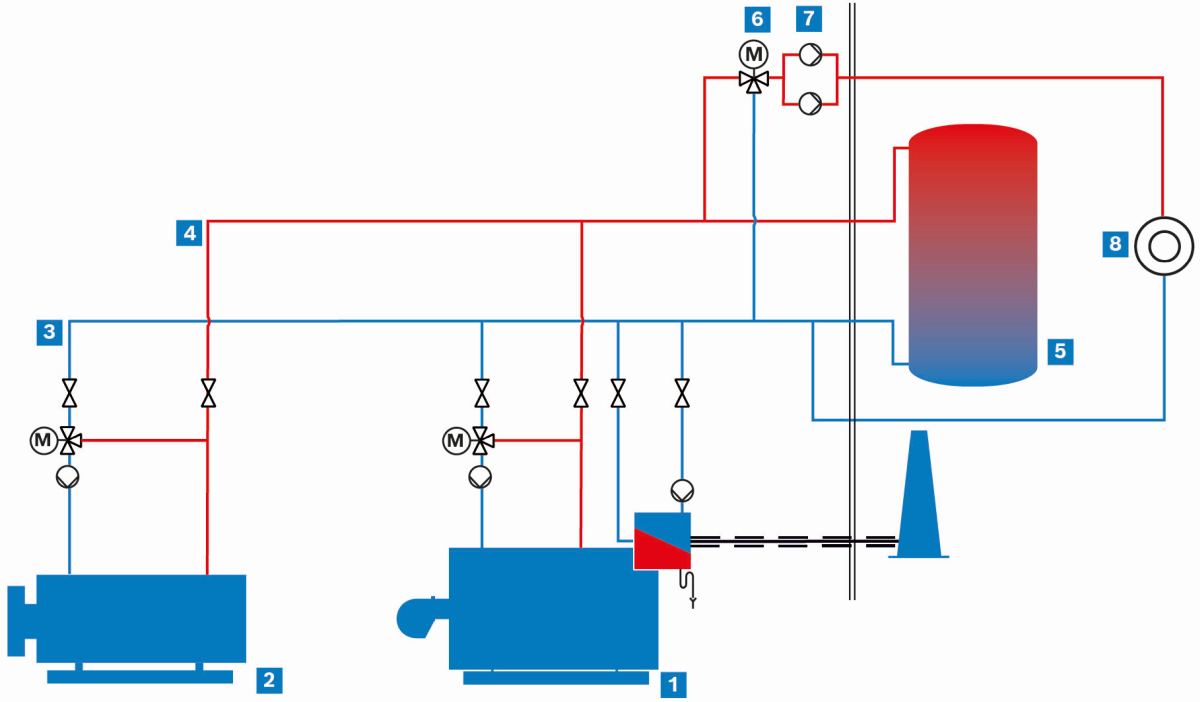
Diagram of a hot water system with an electric hot water boiler and a heat cylinder acting as a hydraulic separator
|
|
Hot water boiler 1 |
|
|
Electric hot water boiler 2 |
|
|
Return |
|
|
Flow |
|
|
Heat cylinder as hydraulic separation |
|
|
Three-way valve for the flow temperature control |
|
|
Mains-powered circulation pumps |
|
|
Heat consumer |