
Pressure limiter / Pressure gradient diagram
When determining the maximum permissible working pressure for the individual components of the entire system, the maximum permissible flow temperature, the geodetic elevations of the system components and the switching intervals necessary for the safety and control of the system must therefore be taken into account.
Working range of the pressure maintenance
The pressure maintenance working range for hot water and heating boilers is determined to ensure that the pressure in the heating system remains within defined limits.
The maximum system pressure or working range of the pressure-maintaining systems is determined by the structural and safety-related limits of the system, including the permissible operating pressure of all components, the safety valve relief pressure, the geodetic height, the thermal expansion of the water, and the applicable local standards and regulations.
Minimum pressure limiter
The purpose of the minimum pressure limiter (pmin) is to shut down the boiler system before the pressure in the system drops so low that steam escapes at critical points (geodetically highest points) in the hot water network. This is the minimum working gauge pressure required to prevent evaporation from occurring at the highest point of the system.
The setting of pmin is usually carried out as follows:
pmin = boiling pressure (at the response temperature of the safety temperature limiter) + geodetic height [in bar] (maximum installation height of a consumer or a mains pipe above the boiler or pressure maintenance system) + safety margin (approx. 0.2 bar or in accordance with national regulations)

Maximum pressure limiter
The maximum pressure limiter (pmax) has the task of switching off the heating, in this case before the safety valve is activated.
pmax is usually set as follows:
For boilers with a safety temperature limiter ≤ 110 °C:
pmax = safety valve trip pressure – 0.2 bar
For boilers with a safety temperature limiter > 110 °C:
Pmax = safety valve trip pressure – 10 %
Pressure gradient diagram
The starting point for setting the system is the highest required flow temperature of the consumers, e.g. 85 °C. In order to adequately cover the control range of the combustion output control, the safety temperature limiter must be set to at least 7 K above the flow temperature, i.e. to at least 92 °C. In heating boilers subject to the Gas Appliances Directive, the safety temperature limiter is often set to the maximum permissible temperature of 110 °C.
The boiling pressure for 110 °C is 0.43 bar.
- The geodetic height must be added to the 0.43 bar, which in this example is given as 76 m. The geodetic height is the actual difference in height between the position of the pressure limiters on the boiler and the highest point of the system. The geodetic height must be converted into pressure using the density of the medium. The density is determined at maximum temperature (safety temperature limiter).
- A safety margin of at least 0.2 bar must also be added to the pressure limiter.
- The minimum margin from the pressure limiter on the boiler to the working range of the pressure maintenance is 0.3 bar.
- The working range of the pressure maintenance depends on the type of pressure maintenance, in this case 1.0 bar.
- The minimum margin between the highest pressure (end pressure) in the pressure maintenance working range and the excess pressure of the safety valve is 10 % of the excess pressure of the safety valve, but at least 0.5 bar.
- The max. pressure limiter is set with a safety margin of 0.2 bar from the safety valve trip pressure.
This results in a safety valve trip pressure of 10 bar, or in other words, with a safety valve trip pressure of 10 bar, the maximum geodetic height can be 76 m.
The pressure rating of the boiler must be equal to or greater than the opening pressure of the safety valve.
Information about pressure-maintaining systems
If the maximum and minimum pressure limiters of the boiler and pressure-maintaining system are at different geodetic heights, this must be taken into account when setting the maximum and minimum values on the pressure-maintaining systems.
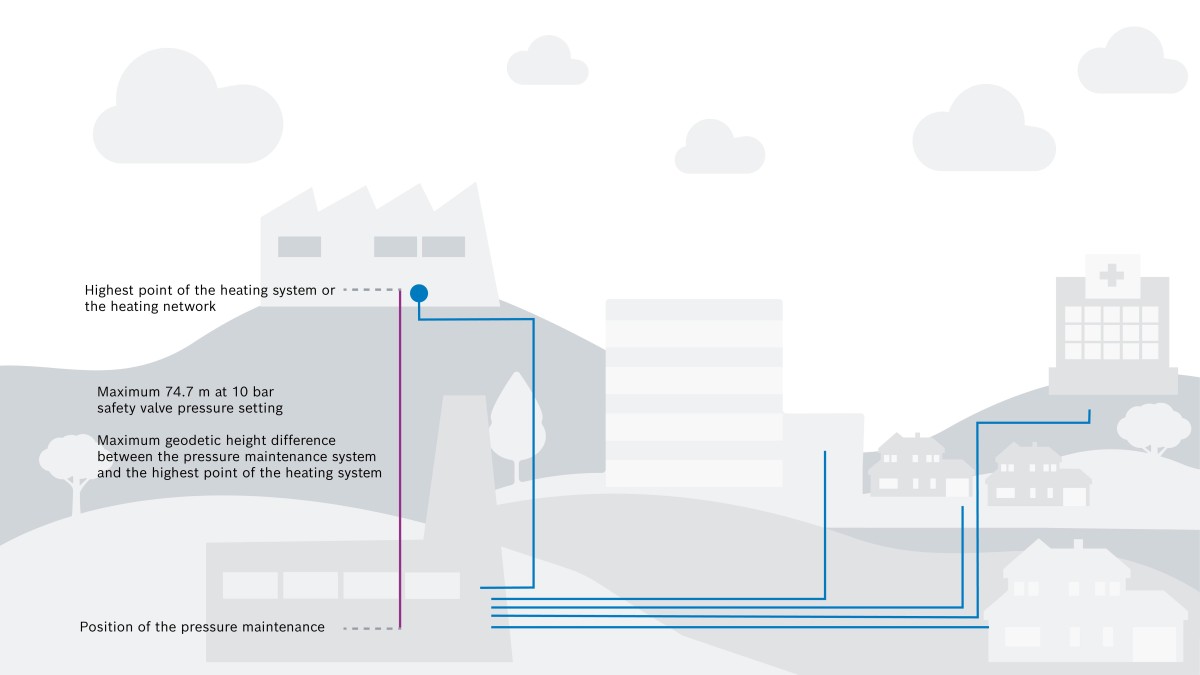
The geodetic height takes into account the difference between the installation height of the pressure-maintaining system and the highest point of the system