
Annual efficiency

|
|
The supplied heating energy Qzu,a for a year is determined from the fuel energy actually consumed. To this end, the fuel quantity is measured using appropriate counters and multiplied by the net calorific value.
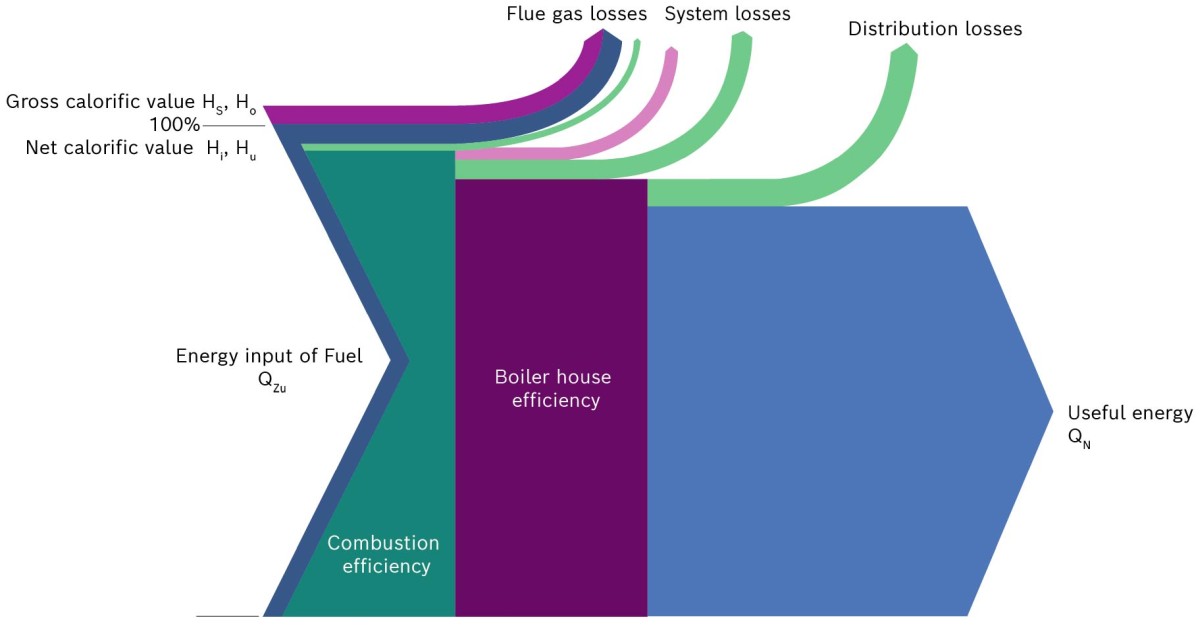
Sankey diagram (energy flow diagram) of a hot water boiler system
|
|
Latent heat of the flue gas |
|
|
Sensible heat of the flue gas |
|
|
Radiation and conduction (including standstill losses) |
|
|
Pre-ventilation losses |


The amount of energy QN,a actually used in operation is determined using a heat quantity calculator. The useful heat quantity is calculated from the water volume and the difference between the flow and return temperatures. Measured and totalled over a year and divided by the amount of energy contained in the fuel, this gives the annual efficiency of the system.
The annual efficiency of a hot water boiler system therefore includes all operational losses associated with energy generation, such as flue gas, start-up, standby and heat losses from the boiler systems.
A boiler efficiency of 95 % may contrast with an actual annual efficiency of only 60 %.
Particularly when the average boiler load is very low, the conduction and radiation losses, which are generally independent of the boiler load, are very high in relation to the fuel heat used. In addition, there are losses due to pre-purging of the boiler system when the burner is cycling.
If the system is very often only kept warm or operated at partial load, 20 – 40 % of the fuel required to operate the system may sometimes be lost.
|
|

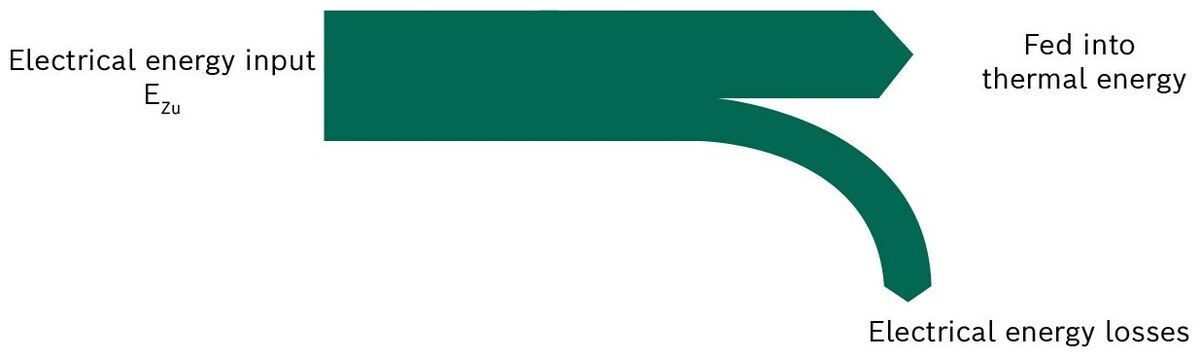
Sankey diagram of the electrical energy of a hot water boiler system (not to scale with Sankey diagram)
Losses of electrical energy must also be taken into account. Due to their significantly smaller absolute energy share compared to heat, they are only minor in the overall energy balance, but play an important role due to the high cost of electrical energy.