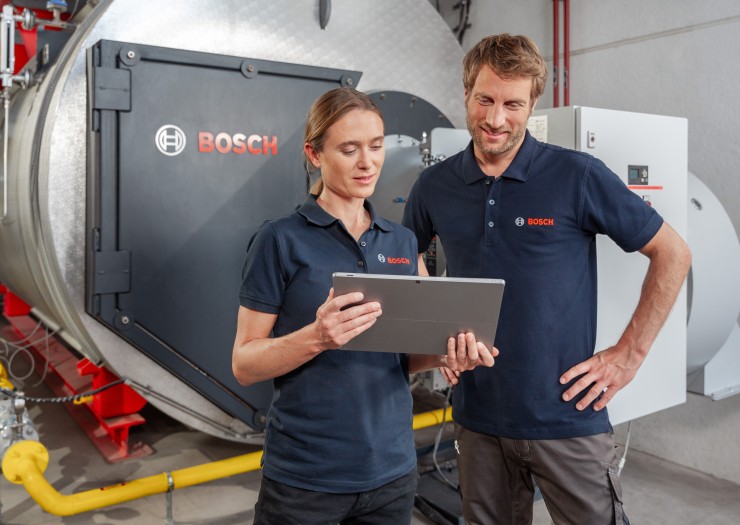
Modernisation

Modernisation of an existing system in accordance with the latest standards
With good maintenance, hot water boiler systems often operate reliably for ≥ 30 years. Due to technical advances in control, combustion and heat recovery technology, almost all hot water boiler systems that are more than 15 years old are in need of modernisation:
- System and boiler components (e.g. variable-speed combustion fans and pumps, O2- and CO-controlled combustion systems, NOx-reduced combustion systems, heat recovery devices such as condensing heat exchangers)
- Regulation, control and monitoring technology (e.g. sensors, programmable logic controllers, regulation and monitoring logic, control and telecontrol technology, safety technology)
Additional modernisation requirements arise from increased demands in the following areas:
- Environmental protection
- System efficiency
- Regulations and laws (e.g. emissions from combustion systems, obligation to implement energy management or audits)
Furthermore, businesses and their consumers also evolve significantly over time, meaning that the way boiler systems are operated today is usually far removed from their original design. According to a study by the German Heating Industry Association (BDH), there is a considerable backlog of modernisation work in the field of heat- and steam-generation systems. More than 80 % of existing systems in Germany are operated inefficiently. Appropriate measures may increase energy efficiency by 20 – 30 %.
Our modular system components make it easy and efficient to retrofit existing systems. In many cases, the modernisation measures pay for themselves within 1 – 2 years.
The following table provides information about which measures are particularly suitable for retrofitting, as they can be implemented easily and without major operational disruptions. The table also provides an indication of which measures may lead to which savings. With good planning, combining individual measures may create additional synergy effects.
- Very simple: Minimal planning effort, no changes to the existing control system required, and can usually be implemented during ongoing operations or with only very short interruptions to operations
- Simple: Can be implemented with slightly more complex planning, retrofitting in the control cabinet and short interruptions to operations
- Complex: Can be implementedwith major renovation work and operational interruptions
|
Particularly suitable for retrofitting |
Savings potential |
Implementation effort |
|
Replacement of defective or missing insulation (e.g. valves, inspection openings) |
3 – 8 % fuel |
Very simple |
|
Renewal of the control and safety technology |
1 – 3 % fuel |
Simple |
|
Burner replacement for power adjustment |
≤ 8 % fuel |
Simple |
|
Combustion control, O2 and CO control |
≤ 1.0 % fuel |
Simple |
|
Fan speed control |
≤ 75 % electricity costs |
Simple |
|
Speed control for pumps |
≤ 75 % electricity costs |
Simple |
|
Automated condition monitoring and controller optimisation |
1 – 3 % fuel |
Simple |
|
Flue gas heat exchanger |
5 – 7 % fuel |
Simple |
|
Condensing heat exchanger |
5 – 7 % fuel |
Simple |
|
Conversion from oil to gas operation, use of multi-fuel firing systems |
≤ 25 % costs, |
Complex |
Measures for retrofitting with the respective savings potential