
Flue gas heat exchanger
Operating conditions
- Return flow temperature > 60 °C
- Almost always makes economic sense
- For boilers up to approx. 3 MW flue gas heat exchanger, full flow
- For boilers from approx. 3 MW flue gas heat exchanger, partial flow
By using an integrated or downstream flue gas heat exchanger, the flue gas temperature can be cooled to 120 – 140 °C, depending on the return temperature and the design of the flue gas heat exchanger, thereby significantly reducing the flue loss. The flue gases transfer their heat to the return water via a special finned pipe system, which improves heat transfer. This increases the combustion efficiency by 5 – 7 %.
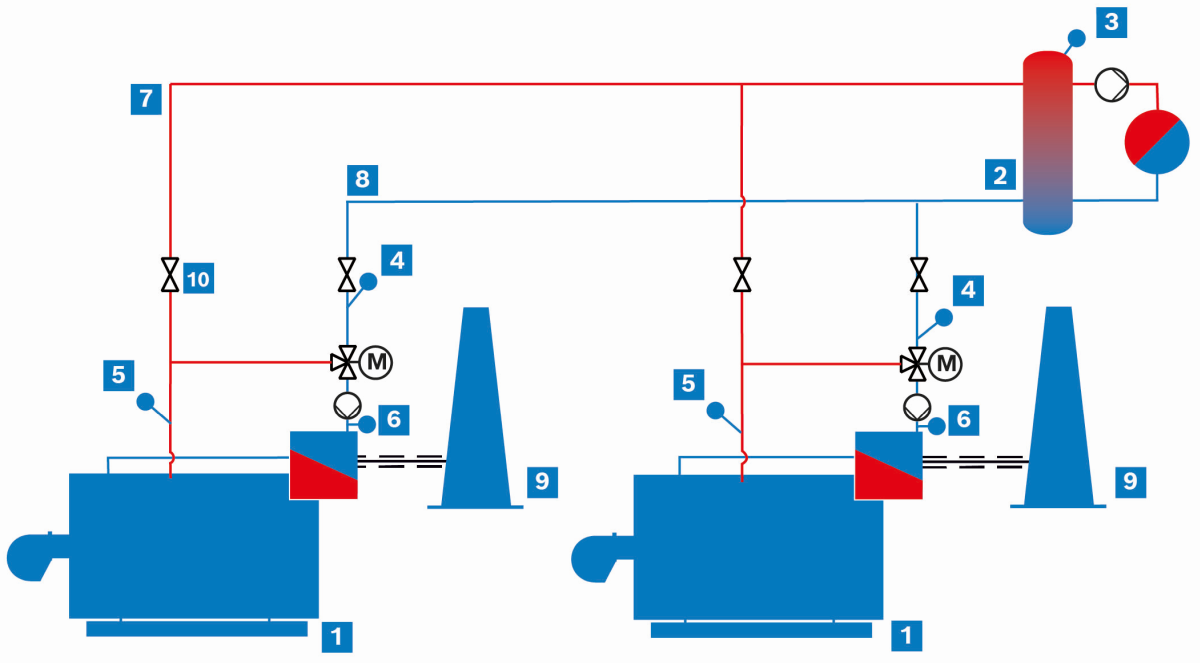
Full-flow flue gas heat exchanger (simplified schematic representation)
|
|
Hot water boiler |
|
|
Low loss header |
|
|
Network flow temperature |
|
|
Return flow temperature |
|
|
Flow temperature |
|
|
Eco intake temperature |
|
|
Flow |
|
|
Return |
|
|
Chimney |
|
|
Shut-off valve |


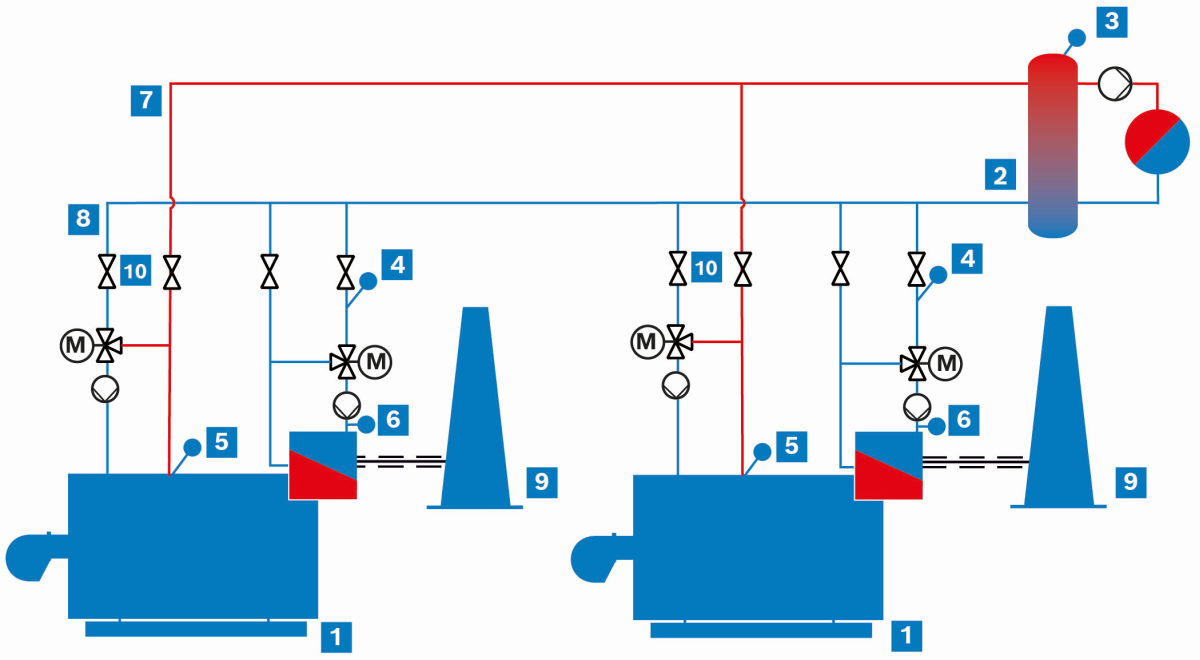
Partial-flow flue gas heat exchanger (simplified schematic representation)
|
|
Hot water boiler |
|
|
Low loss header |
|
|
Network flow temperature |
|
|
Return flow temperature |
|
|
Flow temperature |
|
|
Eco intake temperature |
|
|
Flow |
|
|
Return |
|
|
Chimney |
|
|
Shut-off valve |
Unregulated flue gas heat exchangers the optimal efficiency gains because, under partial load, the available heating surface is optimally utilised to cool the flue gases to protect the flue gas heat exchangers from corrosion at low return temperatures (< 60 °C), there are various ways to increase the return temperature. This type of control also allows the minimum permissible chimney temperature to be taken into account. In this case, flue gas heat exchangers can be individually designed for different flue gas temperatures. By increasing the heating surface area of the flue gas heat exchanger, the flue gas temperature can be reduced significantly by up to 30 °C, thus improving efficiency by approximately 1.5 %.
The integrated flue gas heat exchanger is now standard equipment in hot water boilers in almost all applications. It usually pays for itself within a few months.