
Alternative fuels/energy sources
In addition to conventional fuels such as gas and oil, there is an increasing focus on the use of alternative fuels. For several years now, the focus has been on reducing CO2 emissions. Many companies have embedded sustainability in their values and objectives, and are therefore committed to using energy sources that are as environmentally friendly and carbon-neutral as possible.
The following alternative fuels are commonly used in practice:
- Other combustion gases (e.g. hydrogen, liquid gases such as LNG and LPG)
- Biofuels (e.g. low-calorific gases, biodiesel, vegetable oils, sewage and biogases)
- Green electricity (generated using renewable energies, e.g. photovoltaics or wind power)
- Contaminated by-products from the chemical industry (e.g. styrene, toluene)
- By-products from other industries (e.g. animal fat, fish oil)
- Synthetic fuels (not considered below, not economically available)
The fuel properties must be taken into account in particular in the design of the combustion system, the auxiliary units, the boiler and the appropriate flue gas heat recovery measures. The following points should be given special consideration in this context:
- Fuels with high sulphur content (e.g. biogas) or a tendency to form soot (bio-oil)
- Chlorine-containing fuels (e.g. by-products from the chemical industry)
- Fuels that cause heavy deposits on the heating surfaces (e.g. so-called re-refined fuels)
- Fuels with particularly high combustion temperatures (e.g. hydrogen)
- Fuels that require constant reduction in practice (biogas, LNG, gaseous by-products)
Hydrogen
The use of green hydrogen in boiler systems offers a great opportunity to improve the environmental balance of process heat, as its combustion produces water vapour instead of CO2. In addition to CO2 neutrality, the high efficiency of over 98 % in boiler systems is also a major advantage. Green hydrogen is an important energy source for our future and is destined to be used as a fuel for CO2-neutral heating energy and process heat generation.
When used as a fuel, certain factors and differences compared to natural gas must be taken into account: At around 2000 °C, the combustion flame is considerably hotter than that of natural gas, for example, which promotes thermal NOx formation. Suitable technical countermeasures, such as flue gas recirculation or appropriate flame tube geometry, remedy this by reducing hotspots in the combustion chamber.
The issue of safety must also be considered separately. Hydrogen burns and ignites more rapidly, which is why the mixture of hydrogen and oxygen is also known as oxyhydrogen gas. It is essential that the unintentional formation of detonating gas is prevented. As the smallest atom in the universe, hydrogen is able to diffuse through a variety of materials and even metals.
These aspects and other technical requirements must be taken into account for the safe handling of hydrogen. Further information about hydrogen is summarised in the technical report “Heating and process heat with climate-neutral hydrogen”.
Biogas/bio-oil
Biogas and sewage gas are produced during the decomposition of organic matter by microorganisms. The gas usually consists largely of methane, but often contains other by-products such as sulphur. Composition and proportions may vary greatly, which is why regular analyses and continuous combustion control are recommended. The same applies to bio-oil. Unlike bio-oil, biogas cannot be stored economically on a large scale. Therefore, consumers should be able to use this flexibly at any time. It also makes sense to integrate a second energy source into the system in order to decouple the timing of biogas production and process heat demand.
In addition to fluctuations in the composition and net calorific value of bio-oil, it often contains impurities and other components that may lead to soot formation. In this case, frequent (even daily) cleaning of the flue-gas-side heat exchanger surface areas is necessary, as deposits have a negative impact on heat transfer and thus efficiency. Sophisticated pneumatic solutions can be used for fully automatic cleaning during operation. Compliance with flue gas emission limits must be checked on a case-by-case basis, particularly for bio-oil.
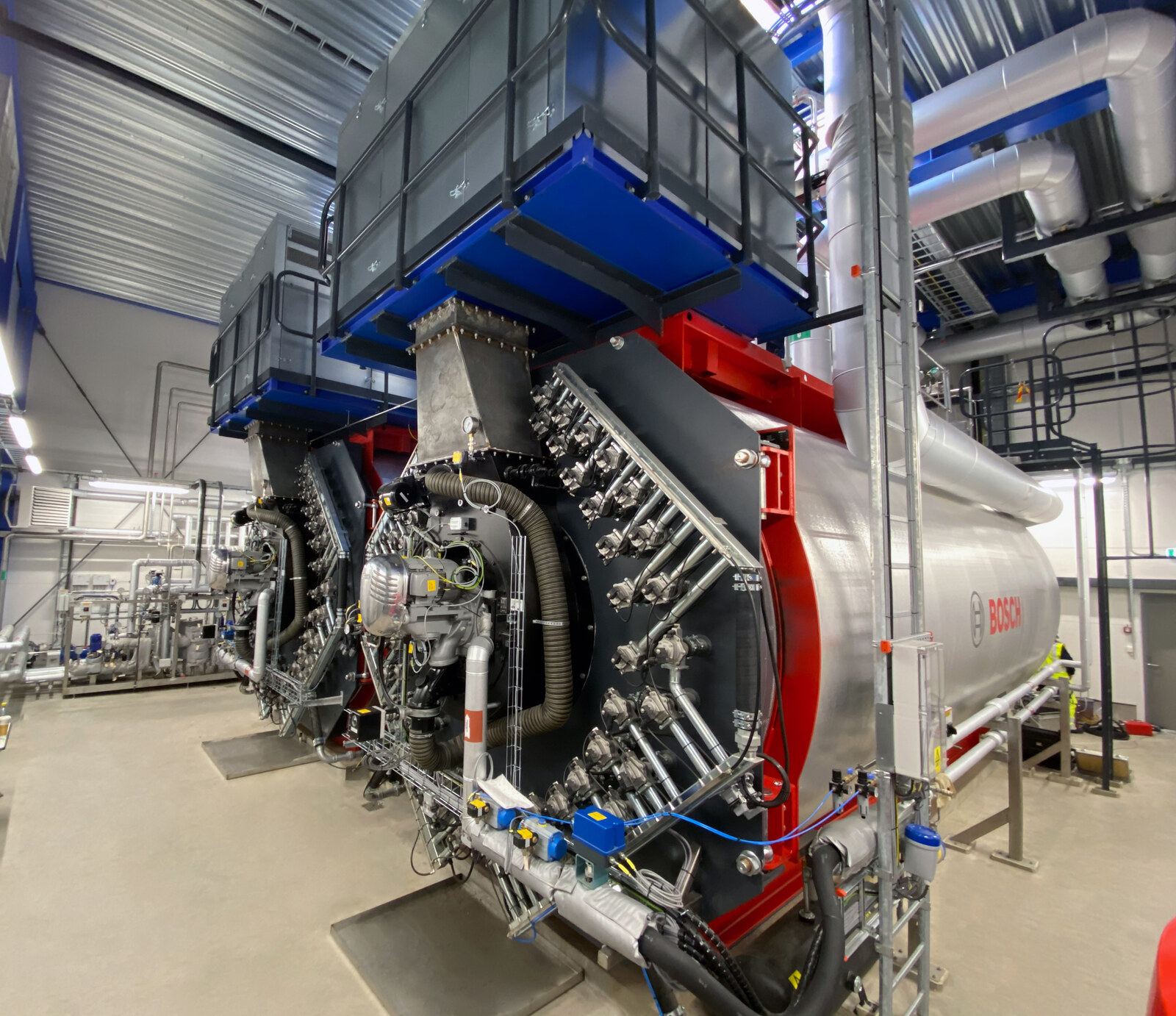
Bosch bio-oil boiler with innovative compressed air cleaning system at Eidsiva Bioenergi AS in Denmark
Liquid biofuels may also contain tiny particles. In the worst case, these may regularly block the burner nozzles. Rotary atomiser burners are significantly less susceptible in this regard if particle-free fuel quality cannot be guaranteed.
Biomass
Biomass essentially refers to renewable solid fuels such as wood, pellets and, less commonly, nut shells or other plant residues. It is usually inexpensive or even a waste product, can be stored and is available almost worldwide. However, storage, space requirements and logistics are usually significantly more complex than for liquid or gaseous fuels.
Opinions differ on the assessment of sustainability. When burned, CO2 that was bound from the atmosphere during the plant’s “lifetime” is released. In the case of annual plants (see biogas from maize, nut shells), CO2 sequestration occurs very quickly. The situation is different with firewood – it may well be over a hundred years old, and there are alternative uses for the material without releasing the chemically bound CO2 (e.g. as construction timber). Increasingly, attention is also being focused on CO2 emissions from biomass manufacture, particularly in the case of wood pellets (drying, transport). In addition to CO2, biomass combustion also produces higher levels of pollutant emissions, including NOx, sulphur and particulate matter. Depending on the fuel and installation location, flue gas purification may therefore be advisable or mandatory.
For systems where constant availability is highly important, additional systems using other energy sources are often used as backup, e.g. an additional boiler using conventional fuels.
Green electricity
Why not use green energy directly? The use of purely electric hot water generators in commercial and industrial processes is highly attractive from a technical point of view. The boiler house no longer needs a fireplace and is also future-proof with respect to emissions.
Electric heat generators have their merits: Energy costs are less significant, particularly for smaller businesses or, for example, hospitals that only require heating for a few hours per week. Additionally, the natural gas network has not been extended to cover rural areas comprehensively. Similarly, some businesses have photovoltaic systems or nearby wind farms, for example, and can greatly increase the proportion of green electricity they use themselves by using electric boilers. Decisive factors for “power-to-heat” include energy prices and the underlying policies in the corresponding country. In regions with low energy prices and correspondingly well established network infrastructures for large consumers, the use of electrically heated steam boilers is already on the rise. Electric heat generators are also becoming increasingly attractive for reasons of supply security, so that an alternative to other fuels is always available.
Product: Electric boiler for heating and hot water ELHB
Information about equipment and control
Other alternatives, such as the integration of electrically powered heat pumps, are usually only cost-effective in manufacturing companies for low-temperature applications, e.g. for heating purposes with a flow temperature of < 70 °C. In contrast, many production processes require steam and hot water, often at temperatures far exceeding 100 °C. At these high temperature levels, the efficiency (more precisely, the Coefficient of Performance) of heat pumps is lower – as a result, they can only be operated cost-effectively in individual cases. Furthermore, there is often no sufficient source of waste heat available to supply the heat pumps, since the achievable increase in temperature is usually less than 50 Kelvin, e.g. from 15 °C to 65 °C.