
Heat maintenance system
For short- and medium-term periods of operation during which the boiler is not heated, it is recommended that the boiler be kept warm. This allows the boilers to be operated gently, avoiding start-up condensate and cold starts, and ensuring that heating capacity is quickly restored.

Water can form layers with a temperature difference of up to 80 °C for every 1 m difference in height (shift-load cylinder)
When maintaining the temperature, care must be taken to ensure that a uniform temperature is maintained from the top to the bottom of the boiler, so that no temperature stratification occurs as a result of cooling. In the event of significant temperature stratification, thermal stresses arise when the boiler is restarted due to the differing temperatures, which can cause damage to the boiler.
Maintaining the temperature using only the main circulation pump or the boiler circuit pump is not sufficient, as the lack of buoyancy in the boiler causes short-circuiting of the flow between the boiler flow and return lines, resulting in the bottom of the boiler cooling down.
Hydraulic heat maintenance system
Hydraulic heat retention via the network can be achieved whenever there are at least two heat generators in the network. In addition to reserve or peak-load boilers, these may also include CHP units, heat pumps or solar heat generators. In power-to-heat systems, electric heater rods can also be used for heat retention.
Hydraulic heat retention offers the following advantages:- No temperature stratification in the boiler
- Boiler readiness for rapid heat output at the required flow temperatures
- Preventing the flue gas temperature from falling below the dew point when the system is activated
- Preventing cold starts (thermal stress)
- Preventing burner cycles
Hydraulic heat retention can be achieved either by maintaining the return temperature or by raising it. To do this, the burner and, where applicable, the boiler circuit pump or lifting pump associated with the boiler must be switched off.
The shut-off valve in the hot water flow is open and the three-way valve in the hot water return is closed. A small additional heat maintenance pump, connected to the boiler outlet on the suction side, pumps the supply water through the entire boiler – which is to be kept warm – and into the return pipe. This ensures that the entire boiler is heated evenly, thereby preventing temperature stratification. The circulation pump used for keeping the water warm has a very low power consumption, which means it adds virtually nothing to the running costs.
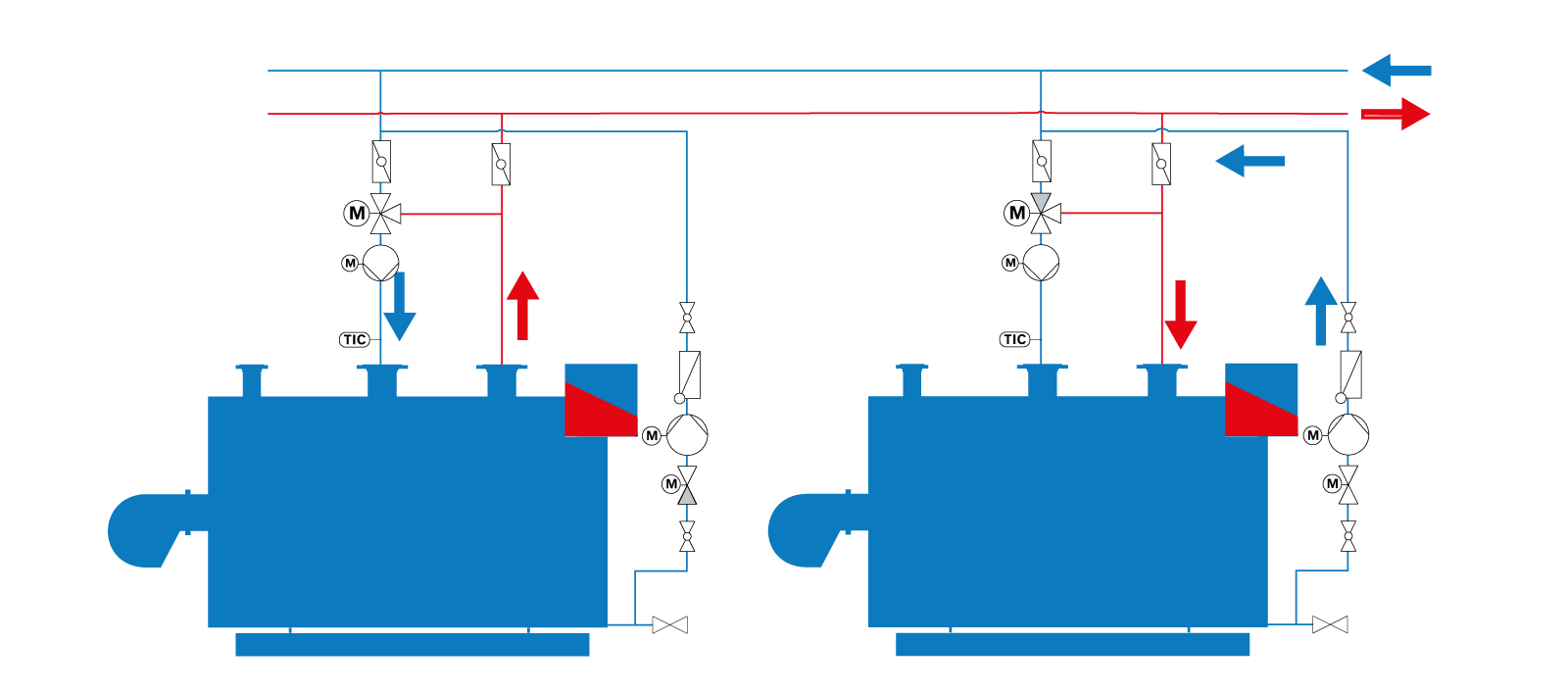
Hydraulic diagrams for return temperature maintenance (left: Heat maintenance system inactive, right: Heat maintenance system active)
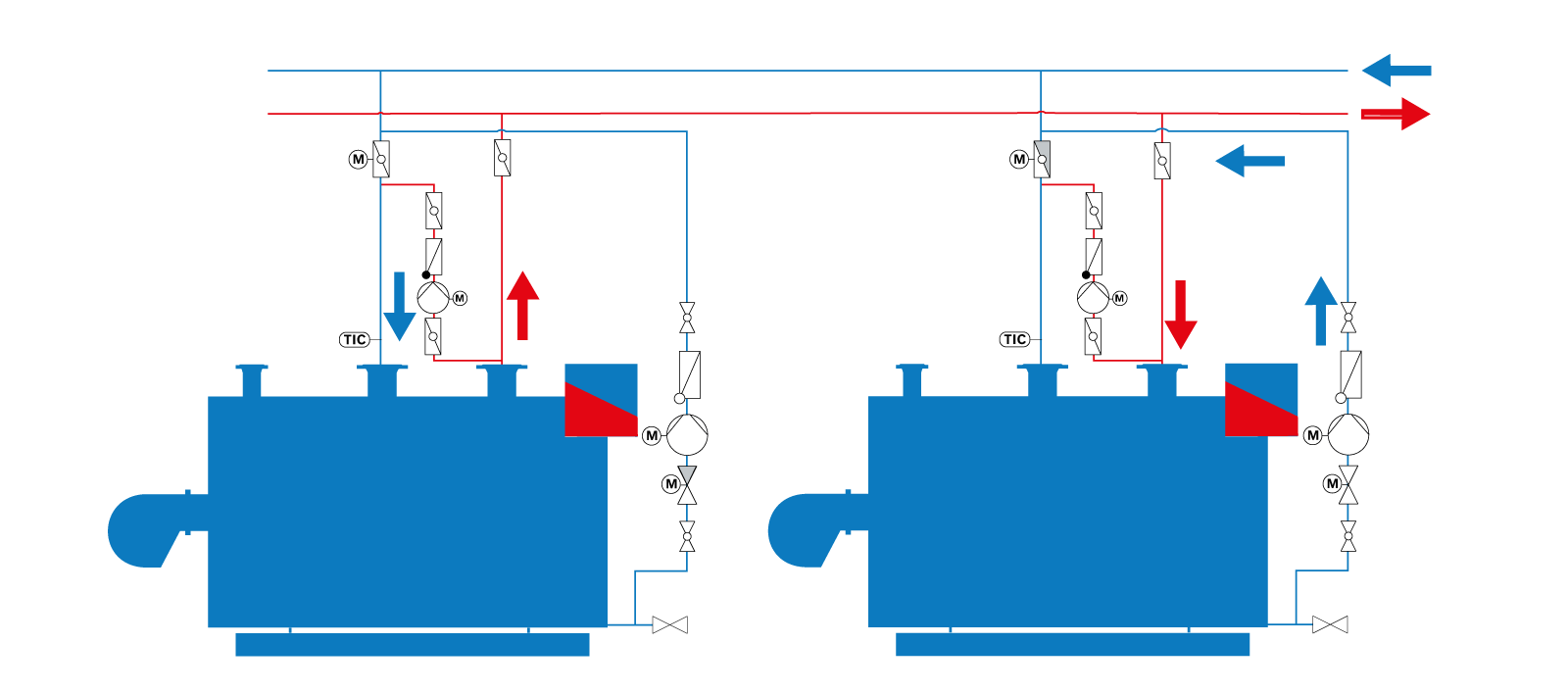
Hydraulic diagrams for return flow temperature boosting (left: Heat maintenance system inactive, right: Heat maintenance system active)