
Combustion efficiency
The combustion efficiency ηf describes the yield of sensible heat generated during the combustion of a fuel. It is determined by calculating the thermal losses qA in the flue gas in relation to the ambient temperature level. Unburned components of the fuel are not taken into account in oil and gas combustion, as they should not occur in relevant quantities in practice.
Information about net and gross calorific values
The combustion efficiency refers to the net calorific value of a fuel and is calculated by subtracting the flue losses from the maximum achievable 100 %.


Excess air
Excess air is the ratio of the amount of air actually supplied to the amount of air stoichiometrically required.
The simplified equation for converting the oxygen content of the flue gas only applies to a flue gas-air ratio of ~ 1.
|
λ |
Excess air |
|
mL |
Actual heat |
|
mL, st |
Stoichiometric heat |
|
O2 |
Oxygen content [vol%] |
To calculate the flue loss, the CO2 or O2 content in the flue gas and the temperature differential between the flue gas temperature and the ambient temperature are determined. In addition, the maximum CO2 content in the flue gas, which depends on the respective fuel, and the Siegert factor f, which depends on the measured O2 content, are required.
If only the carbon dioxide content in the dry flue gas is measured, the following conversion applies:
|
Siegert factor |
Siegert factor |
||
|
Fuel |
CO2,max |
f1 = f (O2 = 0 %) |
f2 = f (O2 = 5 %) |
|
Natural gas L |
11.67 % |
0.4792 |
0.4530 |
|
Natural gas H |
11.94 % |
0.4731 |
0.4469 |
|
EL fuel oil |
15.31 % |
0.4535 |
0.4342 |
|
Propane |
13.69 % |
0.4575 |
0.4352 |
|
Propane-butane |
13.78 % |
0.4570 |
0.4349 |
|
Butane |
13.99 % |
0.4563 |
0.4346 |
|
HVO |
12.5 % |
0.0541 |
0.0721 |
|
Hydrogen H2 |
0 % |
1.013 |
– |
Siegert factors for different fuels
|
Calculation of the Siegert factor for any oxygen content in the dry flue gas O2:
|
|
|
21 % (21 % – O2) |
|
|
Natural gas L |
|
|
Natural gas H |
|
|
EL fuel oil |
|
|
SA fuel oil |
|
|
Natural gas L |
|
|
Natural gas H |
|
|
EL fuel oil |
|
|
SA fuel oil |
|
|
Propane |
|
|
Propane-butane |
|
|
Butane |
|
|
Natural gas GZ35 |
|
|
Natural gas GZ41.5 |
|
|
Natural gas GZ50 |
|
|
Medium fuel oil HL Schwechat |
|
|
Medium fuel oil CLU 3 |


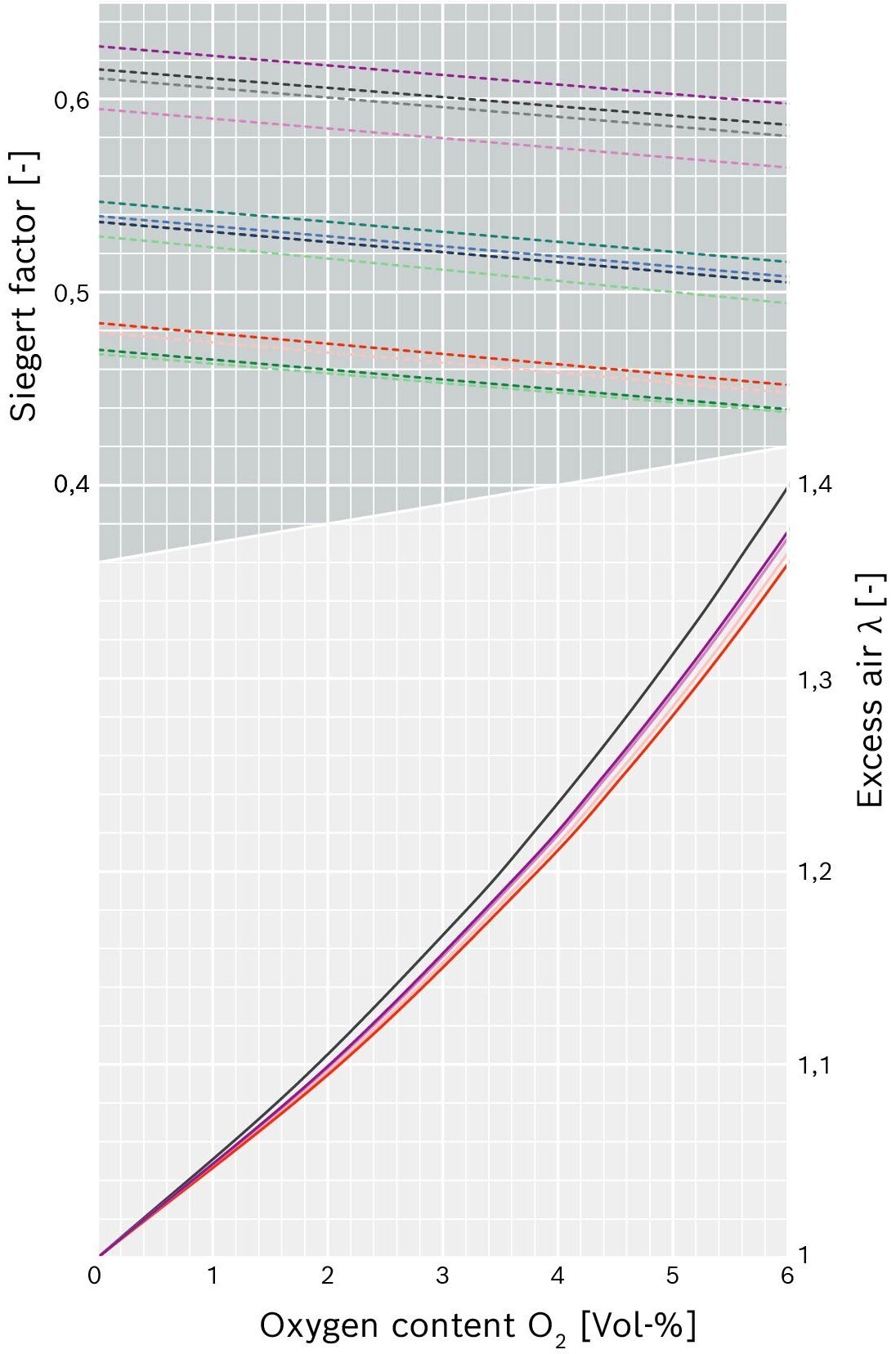
Correlation between oxygen content in dry flue gas, excess air and Siegert factor
Notes:
- For excess air: Natural gas GZ 41.5 / 50, propane, butane, propane-butane are almost identical to natural gas L and are therefore not shown.
- Medium fuel oil CLU 3 and medium fuel oil HL Schwechat are between the curves of fuel oil EL and SA, and are therefore not shown.
The combustion efficiency increases, starting from the full load until roughly 35 % partial load for a hot water boiler system. The excess air and therefore the CO2 content measured in the dry flue gas increases only slightly while the flue gas temperature falls due to more efficient utilisation of the heating surface in the boiler. At a partial load of < 35 %, the greater amount of excess air that is necessary prevails and the combustion efficiency falls again.
Fig. “Efficiency with condensing flue gas heat exchanger”
Fig. “Flue gas temperature with condensing flue gas heat exchanger”
The combustion efficiency is determined, for example, during emission measurements carried out by a competent engineer or by trained customer service engineers. Heat losses due to radiation and conduction at the boiler surface are not taken into account here.
The following diagram shows the dependence of the combustion efficiency on the flue gas temperature for natural gas H at different excess air levels. The higher the flue gas temperature, the lower the efficiency.
The diagram also clearly shows that, especially at high flue gas temperatures, the efficiency gain is particularly high due to a lower excess air, i.e. low λ values.
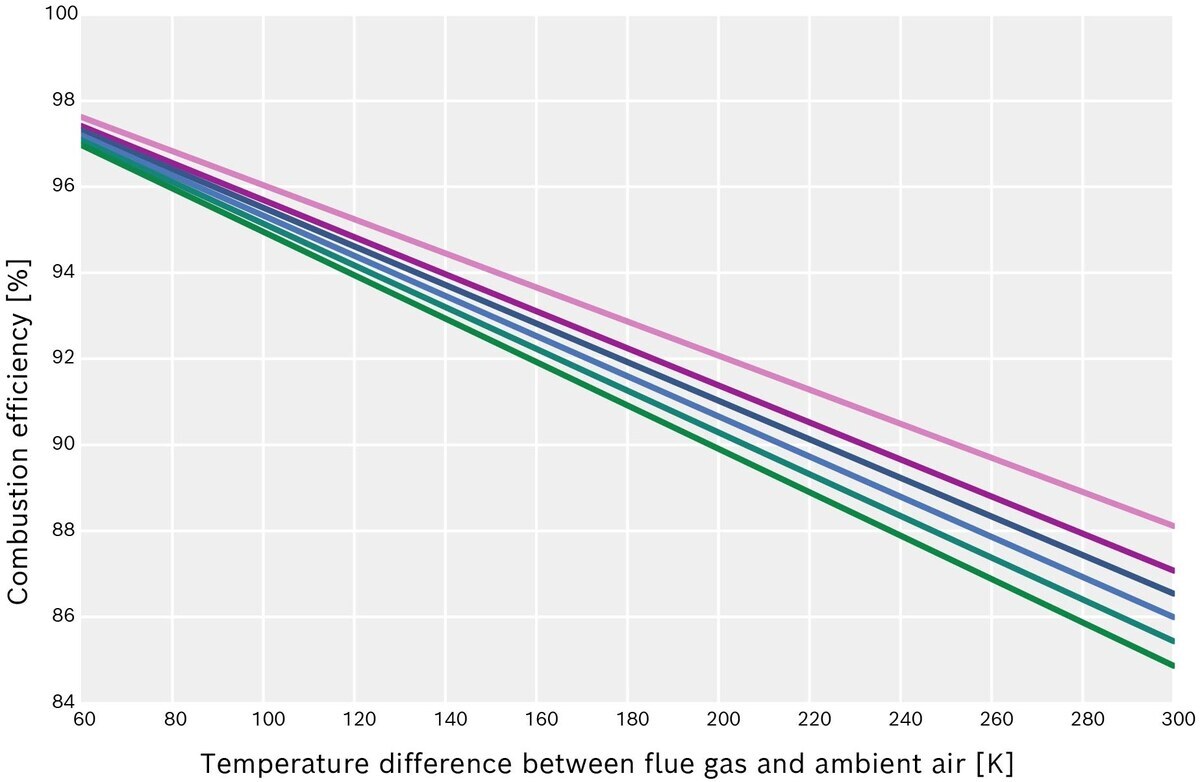
Efficiency curve as a function of excess air λ without condensation, exemplified by natural gas H
|
|
λ = 1 (O2 = 0 %) |
|
|
λ = 1.1 (O2 = 2.14 %) |
|
|
λ = 1.15 (O2 = 3.09 %) |
|
|
λ = 1.2 (O2 = 3.96 %) |
|
|
λ = 1.25 (O2 = 4.77 %) |
|
|
λ = 1.3 (O2 = 5.52 %) |


