
Boiler efficiency
The boiler efficiency ηKcorresponds to the combustion efficiency minus the heat losses at the surface of the boiler to the environment in the installation room during the burner runtime. It can be calculated as follows:

Technical information: Thermal losses through radiation and conduction
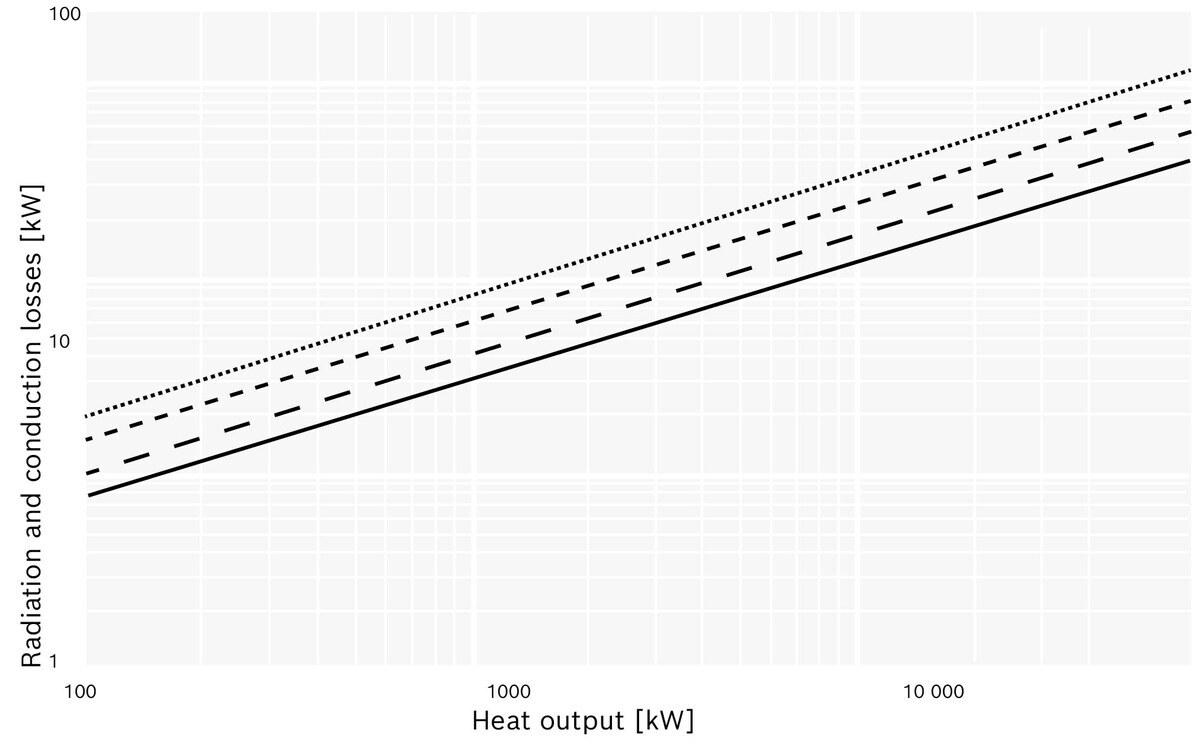
Since the heat losses due to radiation and conduction Q·v,Kcannot generally be measured or calculated in a simple manner, the empirical values in accordance with EN 12953 Part 11 are used for this purpose. These depend on the rated heat output of the boiler on the one hand and on the temperature of the medium on the water side inside the boiler on the other.
These heat losses are independent of the current boiler load and burner operation, and always occur at the same level at the same operating temperatures. In terms of boiler efficiency, this means that the lower the current burner load, the greater the importance of the heat loss. Heat loss also occurs during burner downtimes.
|
|
Average medium temperature 75 °C |
|
|
Average medium temperature 100 °C |
|
|
Average medium temperature 150 °C |
|
|
Average medium temperature 200 °C |


Heat losses due to radiation and conduction depending on the rated heat output of the boiler and the average medium temperature in the boiler with an insulation thickness of 100 mm
With regard to combustion efficiency and boiler efficiency, the manufacturer’s documentation specifies the nominal load case and, where applicable, specific partial load conditions, e.g. at 75 %, 50 % and 25 % of the boiler output. However, a hot water boiler system, especially if it also provides heating energy, operates in all partial load ranges. When heat consumption is very low, the boiler system even switches to operation with longer burner downtimes.
The boiler efficiency cannot therefore be used exclusively as a measure of energy efficiency. In order to better account for the respective times that a boiler system spends at a standstill and in burner operation, the seasonal efficiency must be determined as an evaluation criterion.
Boiler efficiency with utilisation of calorific value
When hydrocarbon chains, as found in most liquid or gaseous fuels, are burned, the flue gas contains not only CO2 but also H2O, i.e. water. At high flue gas temperatures, this water is present in vapour form.
However, if the flue gas temperature can be cooled locally below the dew point, the water vapour in the flue gas partially condenses on the cold heat transfer surfaces and the heat released in the process can be utilised.
Compared to the formula for a boiler without condensing technology, the formula for boiler efficiency is expanded to include the condensation fraction:
The condensate ratio provides the ratio between the actual amount of condensate produced and the theoretically possible condensate ratio in the flue gas, and usually has a value of 0.3 – 0.6, depending on the design.
Efficiency levels of over 100 % when using condensing technology are not a perpetual motion machine, but are solely attributable to the reference basis of the net calorific value Hi. If the energy used were to be related to the physically correct gross calorific value Hs, 100 % would be the maximum achievable efficiency without any losses. However, for reasons of comparability with conventional systems, it was decided to retain the net calorific value as the reference value for condensing boilers as well.
The difference between the net calorific value and the gross calorific value is the latent heat in the flue gas and represents the maximum amount of heat that can be additionally recovered through the condensation of the water content in the flue gas.
With gas fuel, the efficiency increases linearly with the reduction in the flue gas temperature until flue gas condensation begins (at a heating surface temperature of approximately 56 °C). However, when condensation begins in the flue gas, it is no longer the temperature reduction that is decisive, but above all the condensation rate of the water vapour contained in the flue gas. With a correspondingly high condensation rate, efficiency continues to increase dramatically.
The special design of the condensing heat exchanger allows significant amounts of water contained in the flue gas to condense even at very low water inlet temperatures (e.g. inlet water at 15 °C), even if the flue gas temperature measured in the fireplace is well above the flue gas dew point.
In addition to the volume of water, the decisive factor for the condensation rate is, above all, the greatest possible difference between the water inlet temperature and the minimum dew point.
|
Example 1:
|
Example 2:
|
Example 3:
|
|
Natural gas H:
|
Natural gas H:
|
Natural gas H:
|
|
EL fuel oil:
|
EL fuel oil:
|
EL fuel oil:
|
Particularly in the case of oil fuel, it should be noted that, due to the different fuel composition compared to gas, the water vapour content in the flue gas is significantly lower, and therefore the efficiency gain through condensation is also correspondingly lower.